CRE Investors

November 11, 2026
CRE Investors
November 11, 2026
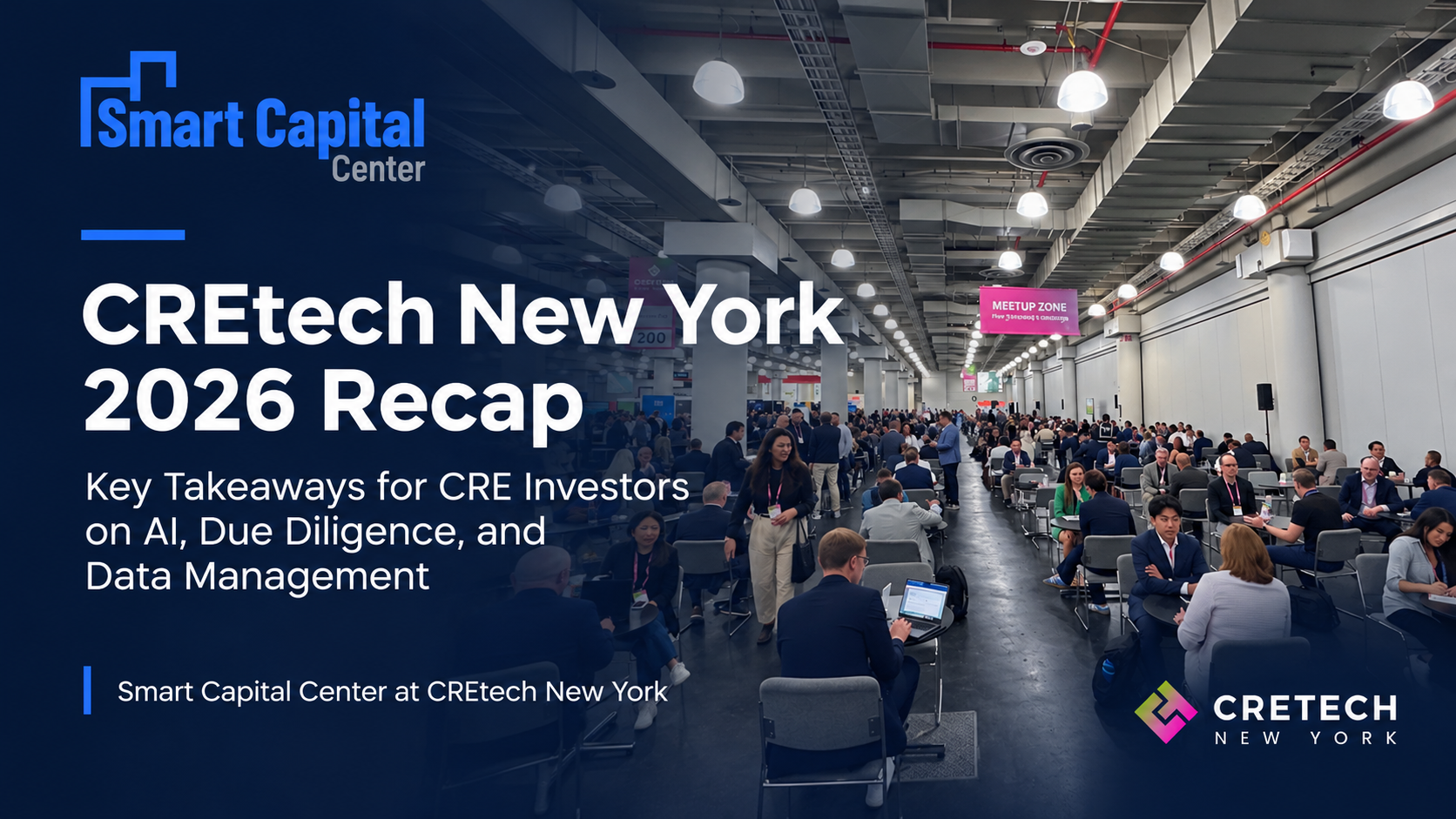
Smart Capital Center joined CREtech New York 2026 at the Javits Center in New York City on October 20 to 21, 2026, where our team attended Main Stage sessions and held meetings with real estate investors, owners and operators. The event ran under CREtech's theme for the year, Real Estate in the Age of AI.
Investors came into the room with a practical problem. The number of AI tools keeps growing, and it is hard to tell which ones will change how fast and how well a team makes deal decisions. Jake Heller, Co-Founder of PLOT Daily, put it plainly from the Main Stage: "There's no shortage of AI tools in commercial real estate, and I almost feel like every day there's 10 new ones." This recap covers four takeaways from the Main Stage and what each one means for commercial real estate (CRE) investment teams making decisions now.
For real estate investors, the message from CREtech was practical. The firms getting real results from AI review every document, trace every number back to its source, and keep one shared set of data from acquisition through asset management. That is how Smart Capital Center's AI agents work for real estate investment teams, giving the same team 10x capacity without adding headcount.
CREtech describes CREtech New York as the leading real estate innovation event, and for investors its value is who was in the room. According to CREtech, 72% of the 3,000 attendees were at the vice president level or above, so the conversations about AI came from the people who set the budgets and decide how their firms use it. Owners and developers who shared their portfolio size reported more than 1.8 million apartment units and 4.3 billion square feet owned or managed, so the lessons came from portfolios large enough to test AI at real scale.
That mix gave investors a rare chance to compare notes with peers who are already using AI. The Main Stage program put leaders from Prologis, BGO, Brookfield, Kimco Realty and Walmart's real estate team alongside technology leaders from OpenAI, Google and Snowflake. Between sessions, CREtech Meetup, which CREtech calls the largest meetings program in real estate, hosted more than 20,000 one-to-one meetings, so investors could test what they heard directly with peers and providers.

The multifamily panel, "The Effective Tech Stack for Multifamily: From Operations to Resident Experience," gave the clearest answer to where AI pays off first. Devang Patel, SVP and Head of Technology at Morgan Properties, described a lease check his accounting team used to handle by sampling. "Instead of spot checking a handful of documents, we now use AI capabilities to run through all the lease documents," he said. The team now compares every lease against the data in its accounting platform.
Once the pilot worked, Patel said, "we quickly realized there's many other applications of this." His team now uses the same process during acquisitions, where a seller's leases can arrive as Word documents, PDFs and data from a different system. Christopher Blackman, Chief Technology Officer at Rose Associates, described a similar result in month-end accounting across hundreds of properties, where AI helped "bring reclass and approvals down to a matter of hours, not days." Heller added that firms that "try and AI everything" struggle, and do better with "a much more specific and practical starting point."
Smart Capital Center brings that full coverage to commercial real estate due diligence. Its AI agents read every rent roll and T12 operating statement in the deal package, standardize the financials to one chart of accounts, and compare what the system calculates with what each document reports. Any variance is highlighted for the analyst, along with alerts such as an expired lease still counted in total rent, a duplicate unit or tenant, or a rent far above or below the rest of the property. These checks are built into the workflow, so they run the same way on every deal, and the team sees problems before they reach the purchase price.
Our comparison of a CRE due diligence platform versus manual review shows how that difference plays out.
More AI output does not help if nobody can check it. KP Reddy, CEO and Founder of Zero RFI, gave a blunt example in his keynote, "Why Buildings Will Cost 30% Cheaper Due to AI." Architects told him that contractors were using AI and sending them 1,500 problems with drawings.
"Of those 1,500 problems, only 5 are real. The rest is AI slop." KP Reddy, CEO and Founder, Zero RFI
Heller raised the same concern about analysts who end up "delegating a lot of their thinking to AI without understanding the fundamentals." The models and decks they produce can look polished while the numbers underneath are wrong, and an investment committee has no easy way to tell.
Smart Capital Center is built so the numbers underneath can be checked. Every figure in the analysis is connected to its original document, so an analyst can click any number and see exactly where it came from. Where two documents disagree, the platform shows both values with their sources. Confidence scores show how certain the system is about each extracted figure, and the reconciliation step flags anything that doesn't match. Your team confirms the numbers are traceable and accurate before they reach the investment committee, and the final call stays with your analysts.

Walmart's session, "Asset Strategy at Scale: People, Data, and Software as One System," showed what changes when every team works from the same data. Samit Batra, Senior Director of Real Estate Asset Strategy at Walmart, manages asset strategy across the company's stores, clubs and distribution centers. He explained why consistent data matters: "If both of us go and scope a store, we'll come back with different results because we are human."
Walmart moved its property condition reviews onto a single data-driven view, and Batra said "all these teams now use one source of truth." The data also changed how capital gets approved. Walmart has "been able to get funding for our capital purchase for next year a couple of months ahead," he said, because leaders could see the evidence behind each request. Reddy made a related point in his keynote: "The silos are fairly efficient, and the incremental gain for making those silos more efficient is fairly nominal." In his view, the bigger gain comes from connecting all the information around the asset.
Smart Capital Center applies that idea to real estate data management for investors. The figures standardized during underwriting carry straight into portfolio views and asset management, where AI agents monitor rent, expenses and net operating income (NOI) around the clock. The platform works with Excel in both directions and inside the systems your team already uses, so acquisitions and asset management teams work from one set of numbers and nobody rebuilds the analysis at each handoff.
Reddy challenged the audience on when decisions get made. "How do you make those decisions before you underwrite a deal versus underwriting a deal and then having to hope and pray that it'll work out?" he asked. He also warned against using AI only to speed up an old process: "If all you do is use AI to do the same process but faster, you're missing the point. You have to change the process." His measure of success was simple: "AI is not about buying tokens and licenses. It's about outcomes. It's about results."
"Capital money is not an expense. It's an investment." Samit Batra, Senior Director, Real Estate Asset Strategy, Walmart
Speakers on the multifamily panel tied the same idea to operating costs. Whitney Arcaro, EVP and Chief Revenue Officer, Residential at RXR, warned that building technology needing replacement every two years "becomes an operational nightmare and it kills your ROI," meaning the return on investment the owner planned for. Eric Cohen, Managing Director, Development and Construction at Kennedy Wilson, said his team brings operations into a project from the very beginning because "our customer is operations."
Smart Capital Center gives investors a smarter, deeper view of every deal before the bid. AI agents run deep research on each tenant, pulling public information, recent news and online sentiment into a strengths, weaknesses, opportunities and threats (SWOT) analysis set up around your own view of tenant risk. They add the property's ownership, sale, tax and mortgage history, summarize the market, and call out the deal's investment highlights and risks, each with its source.
The underwriting model then supports multiple scenarios, so the team can stress test the downside case and its capital expenditure (CapEx) assumptions in a discounted cash flow (DCF) model while there is still time to change the price or walk away. The findings carry into the investment committee memo, so the committee sees the reasoning and the evidence together. After closing, every surprise becomes the owner's cost, so this is the point where deeper analysis pays for itself.
The results show up in speed and conviction. Centers Dynamic Partners underwrites deals 4x faster with Smart Capital Center, and George Arce Jr., its President and CEO, put the value plainly: "As a sponsor, you must know your numbers cold, and Smart Capital Center lets me do that."

Each CREtech takeaway points to the same result for an investment team: more deals reviewed, with deeper analysis and numbers the team can defend. Smart Capital Center's agentic AI for real estate investors covers the whole investment process, from the first look at a deal through asset management, and your analysts stay in charge of every decision. After close, the same platform keeps working for the asset management team, and JLL's asset management team saw a 30x productivity gain with Smart Capital Center.
For the person who owns the budget, the result is capacity. The same team gets 10x capacity with no added headcount. Smart Capital Center is SOC 2 Type II certified, and client data is never shared or used to train models for other clients. Our guide to AI tools for real estate investors explains where these tools fit in the deal process, or you can see it on one of your own deals.
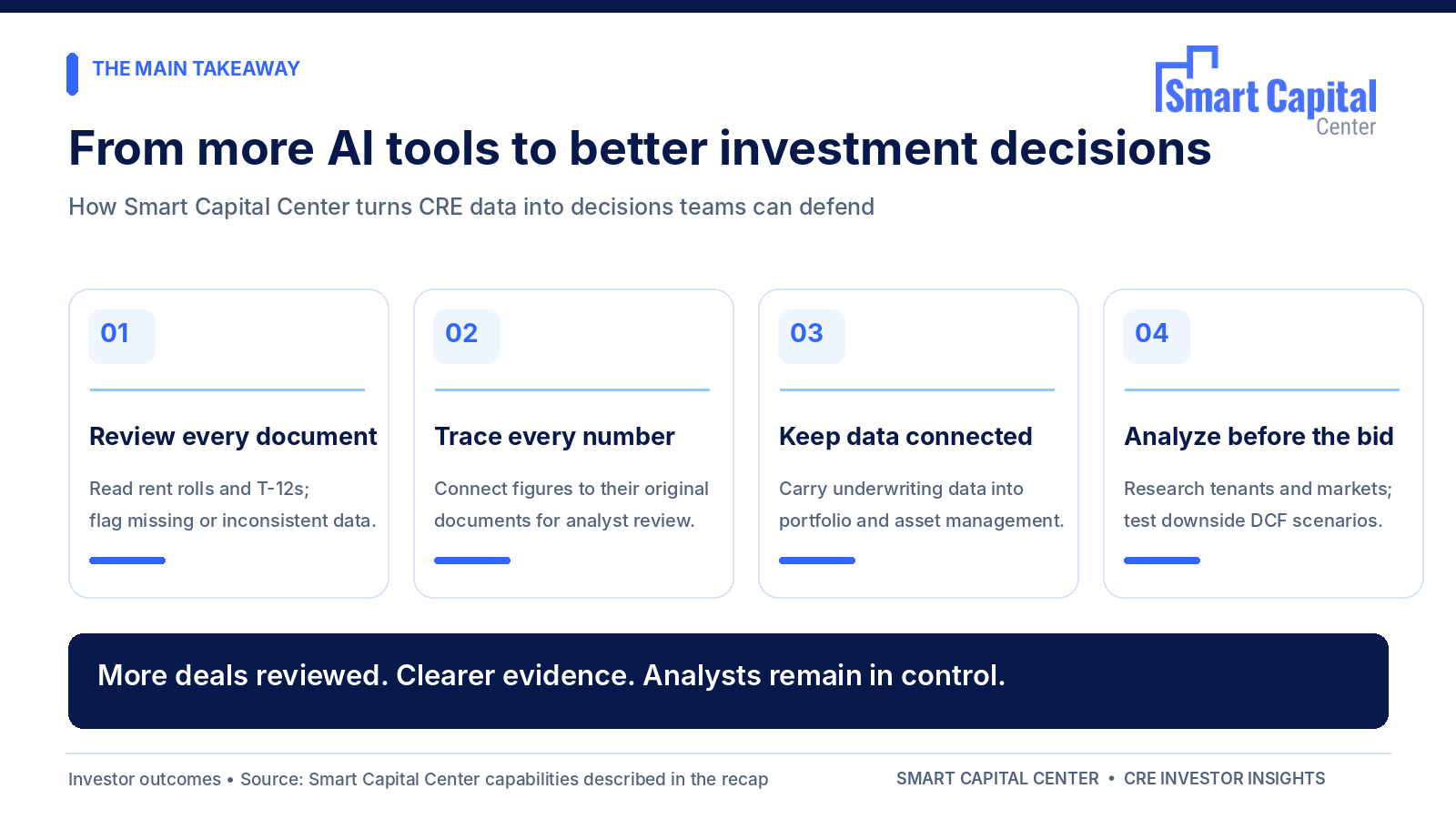
CREtech New York 2026 came back to four concerns investors share: too many AI tools to judge, AI output nobody can check, data split across teams, and decisions made after capital is already committed. The speakers' answer was consistent. The firms getting results use AI to review every document, trace every number to its source, keep one set of data from acquisition through asset management, and finish the deeper analysis before the bid.
For an investment team, that adds up to clear gains: more deals reviewed by the same people, numbers the investment committee can trust, sharper pricing built on deeper tenant and market research, and fewer surprises after closing. Smart Capital Center delivers each of these today, with every figure traceable to its source and your analysts making every call. With new AI tools arriving every week, the investors who choose well now will review more deals, and better ones, than teams still checking a sample by hand.
Put your next deal through Smart Capital Center and see the difference. Every document reviewed, every number traced to its source, deep tenant and market research, and downside scenarios ready before you bid, with 10x capacity for your team. Book a demo today.
Q: How do you use AI for real estate investing?
A: Real estate investors use AI best by starting with one practical task their team can only partly finish today, such as reviewing every lease and operating statement in due diligence, and expanding once it works. Speakers at CREtech New York 2026 described the same pattern and warned that firms trying to apply AI to everything at once tend to struggle. Smart Capital Center's AI agents take on that document and data work across the investment process, so analysts spend their time on pricing and the investment decision.
Q: What are the best AI tools for real estate investors?
A: The best AI tools for real estate investors cover the full deal process, from screening and underwriting through asset management, so the numbers built during acquisition carry into ownership. Every output should link back to its source document, and an analyst should make the final call. Smart Capital Center works this way on one platform, and Centers Dynamic Partners underwrites deals 4x faster with it.
Q: How do you use AI in commercial real estate?
A: Commercial real estate teams use AI to review deal documents, check data across systems, plan capital spending and monitor how properties perform. At CREtech New York 2026, Walmart described getting next year's capital funding approved months earlier by basing requests on data-driven property condition reviews. Smart Capital Center brings the same approach to investment teams, giving the same team 10x capacity without adding headcount.
Q: What is the best AI for commercial real estate?
A: The best AI for commercial real estate is built on real estate data, shows where every figure came from, and works inside the systems a firm already uses. General-purpose chat tools can help with one-off tasks, but each analyst can end up with a different version of the numbers. Smart Capital Center pairs AI agents for underwriting and asset management with 1B+ live market data points across 120M+ properties, and the platform is SOC 2 Type II certified.
Q: How does Smart Capital Center help real estate investors use AI?
A: Smart Capital Center gives real estate investment teams AI agents that review deal documents, prepare the underwriting model for analyst review and monitor assets after close. Every figure traces back to its source, and acquisitions and asset management teams work from the same data. Client data is never shared or used to train models for other clients.