

AI in Commercial Real Estate

July 30, 2026
AI in Commercial Real Estate
July 30, 2026
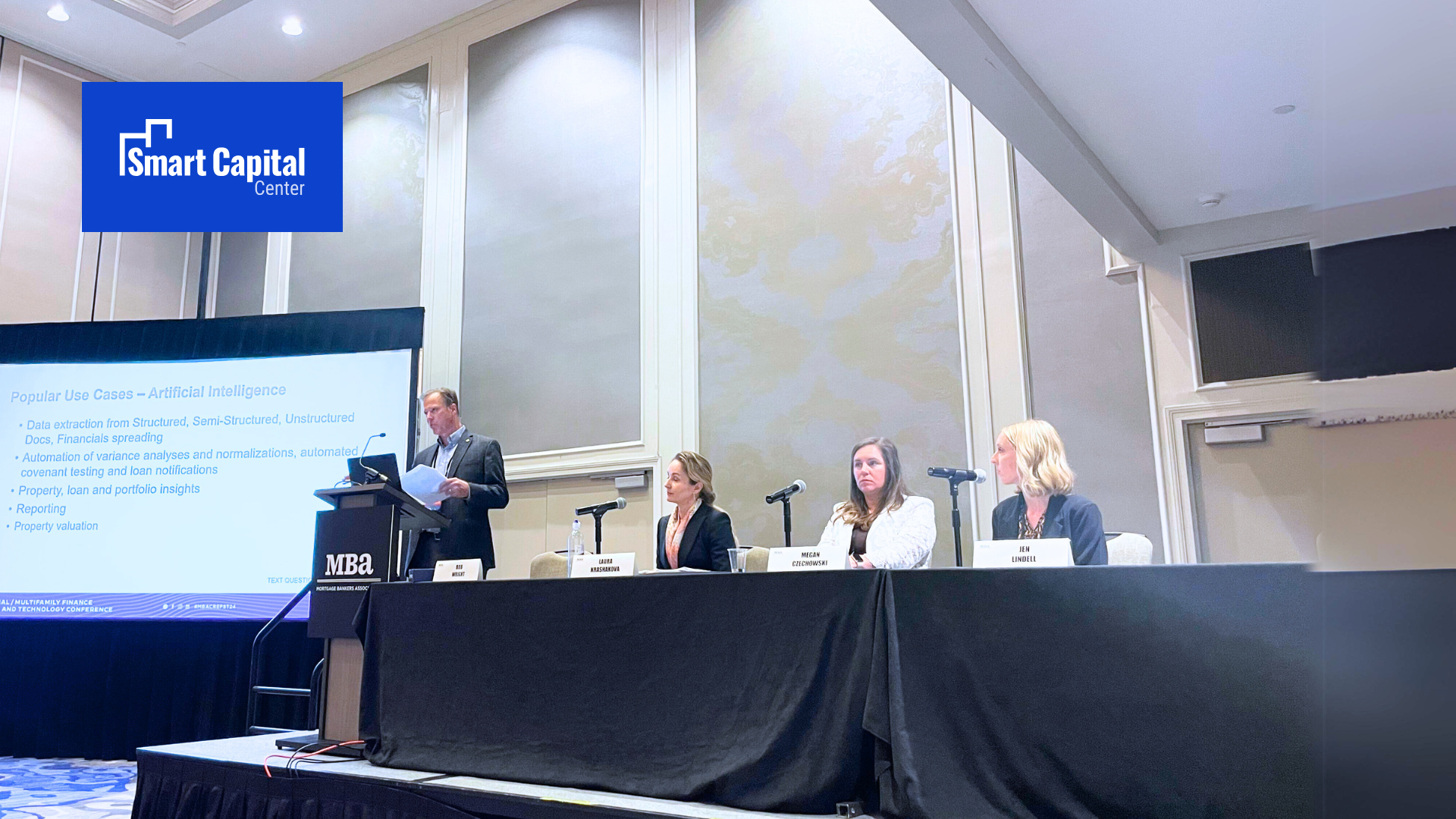
Two years after the MBA Commercial / Multifamily Servicing & Technology Conference (May 19–22, 2024), the questions raised on that stage have been answered by the market. AI and intelligent automation are no longer a roadmap conversation in CRE loan servicing — they are now the difference between servicers who hold margin and servicers who lose it. According to JLL's 2025 Global Real Estate Technology Survey, 88% of CRE investors and operators have started piloting AI, but only 5% report achieving all of their stated AI goals. The gap is now the strategic frontier.
This article distills the key takeaways from the "Transforming Servicing Operations – Leveraging AI & IA" panel — featuring Smart Capital Center CEO Laura Krashakova alongside Jen Lindell (Northmarq), Meghan Czechowski (SVP, Head of Apprise by Walker & Dunlop), and moderator Bob Wright (Managing Director, SS&C Technologies) — and updates each point with the data, deployments, and regulatory context that have emerged since.
A central theme of the panel was the importance of distinguishing AI from IA — terms often used interchangeably but representing different technologies with different deployment patterns:
In production CRE servicing, the two technologies are now layered. IA handles the deterministic spine of the workflow — payment processing, covenant calendars, statement generation — while AI handles judgment-adjacent tasks like document classification, financial spreading from inconsistent rent rolls, and exception triage. The combination is what panelists referred to as agentic orchestration, and it is the architecture behind the productivity gains documented in the CBRE 2025 Tech Adoption Report.
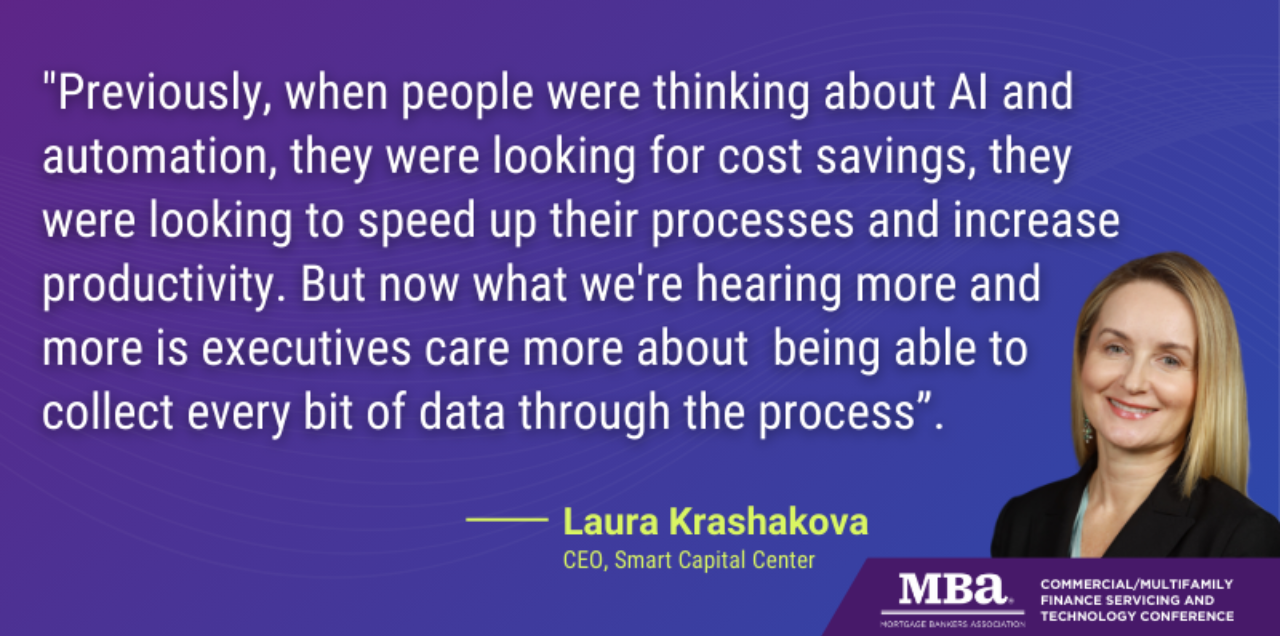
Laura Krashakova's framing on the panel anticipated where the industry is now. As she observed:
"Previously, when people were thinking about AI and automation, they were looking for cost savings, they were looking to speed up their processes and increase productivity. But now what we're hearing more and more is executives care more about being able to collect every bit of data through the process." — Laura Krashakova, CEO, Smart Capital Center
That shift — from "do this faster" to "give me visibility" — has accelerated. The strategic prize in CRE servicing is no longer the per-task cost reduction. It is the structured data trail that automation produces, which feeds portfolio risk monitoring, regulatory reporting, and refinance opportunity flagging in real time.

Joining Smart Capital Center CEO Laura Krashakova were esteemed industry experts, including Jen Lindell of Northmarq, Meghan Czechowski, Senior Vice President, Head of Apprise by Walker & Dunlop, and Bob Wright, Managing Director of SS&C Technologies, Inc., who served as moderator.
The panelists stressed how important AI and IA are in CRE servicing. They noted that the industry relies more on these technologies to solve problems and create new efficiencies.
Jen Lindell noted, "Much of the focus in commercial real estate servicing has been on small parts of a process. There has not been enough attention on automating the entire process."
This indicates a significant opportunity for further automation and optimization in the industry.
Laura Krashakova echoed this sentiment, observing a shift in the perception of the industry on AI and automation. "Previously, when people were thinking about AI and automation, they were looking for cost savings, they were looking to speed up their processes and increase productivity. But now what we're hearing more and more is executives care more about being able to collect every bit of data through the process”.
This concern shows that more people understand the importance of data and insights. They help make better business decisions and improve performance.
The panel surfaced a set of use cases that are now in production at multiple servicers and platforms:
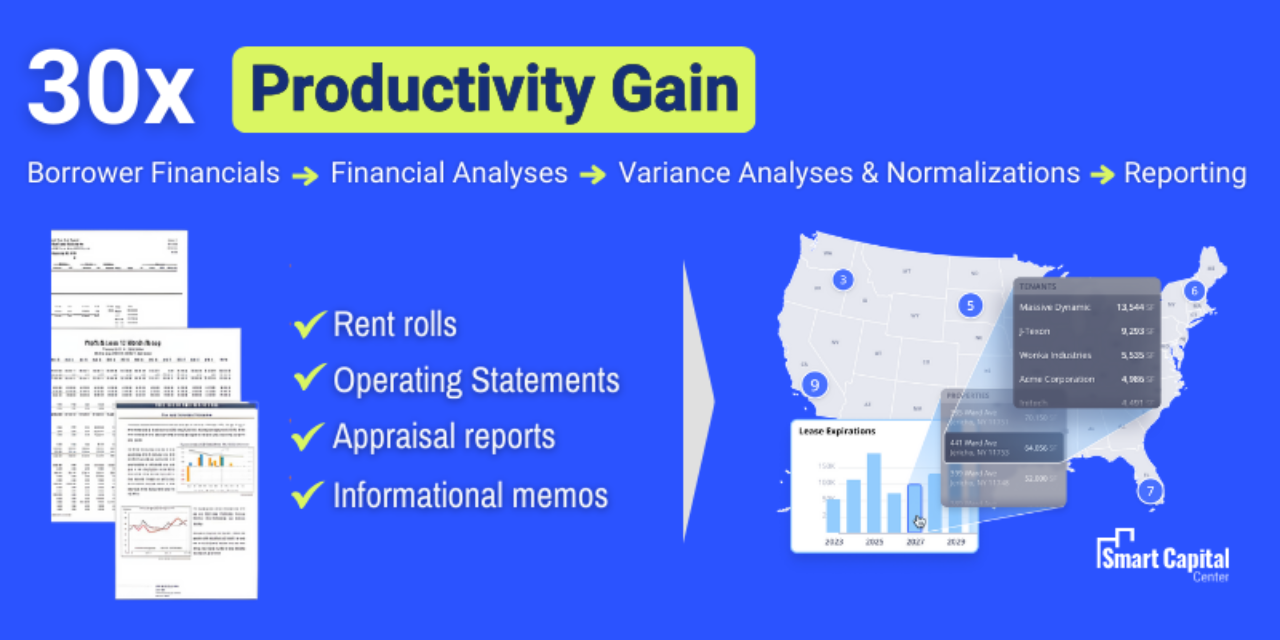
Rent rolls, T-12s, operating statements, appraisal reports, and offering memoranda arrive in dozens of formats — PDF, scanned image, Excel, CSV. AI-powered extraction normalizes these into structured data. This is the foundation that all downstream automation depends on. Smart Capital Center applies AI and IA in tandem to standardize document data while routing borderline cases to human reviewers for final valuation calls.
Every loan in a portfolio carries DSCR, LTV, occupancy, and reporting covenants. Manually monitoring these against incoming financials is prohibitively slow at scale. Agentic AI now runs continuous covenant checks, flags deviations, and generates auditable exception memos. The result: stress in the portfolio is detected weeks earlier than under quarterly review cycles.
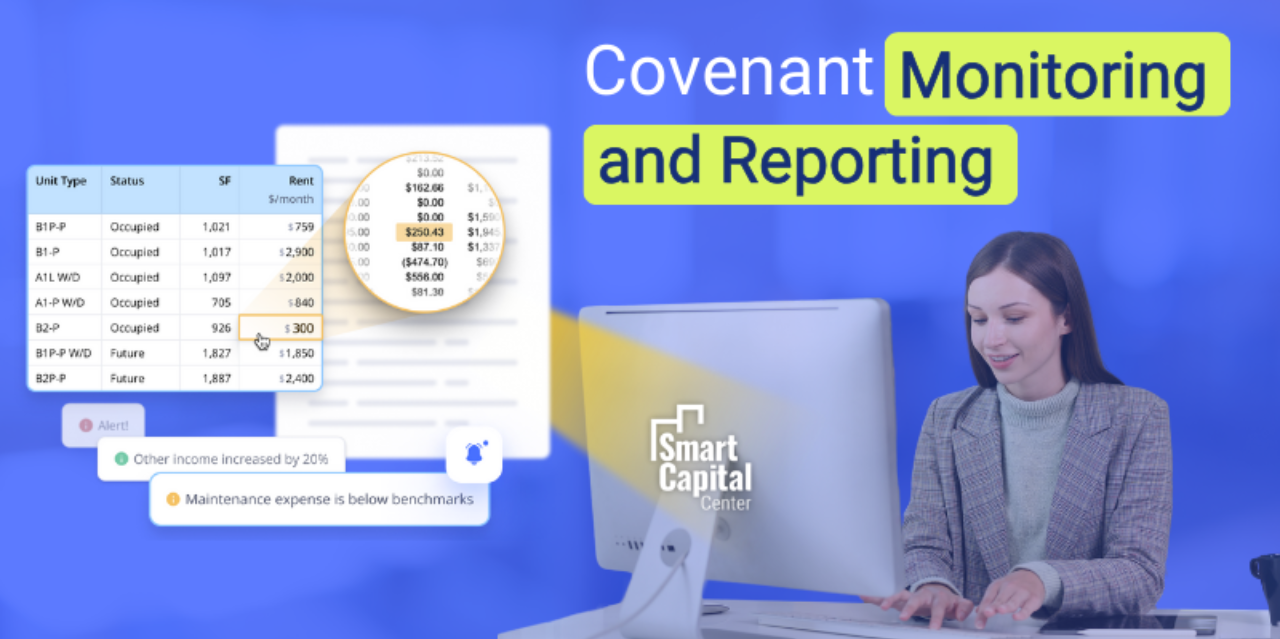
Investor reports, regulatory submissions, and asset-management dashboards that historically consumed days now generate in seconds, drawing on the structured data layer that AI-powered ingestion creates. Consistency improves, and reviewer time shifts from production to validation.
Loan boarding, payoff requests, and assumption approvals involve dozens of handoffs between borrower, lender, servicer, and counsel. IA orchestrates the routing and document collection; AI handles the document interpretation. According to EY, agentic AI can reduce the time spent on manual AML and KYC investigations by 50% by reasoning through complex ownership structures and producing auditable memos.

Laura Krashakova's panel observation that "properly built machines can sometimes check the work of other machines more effectively" is now standard practice. Smart Capital Center automatically reconciles data across documents and flags inconsistencies for human review — significantly reducing the cost of human oversight while improving data quality.
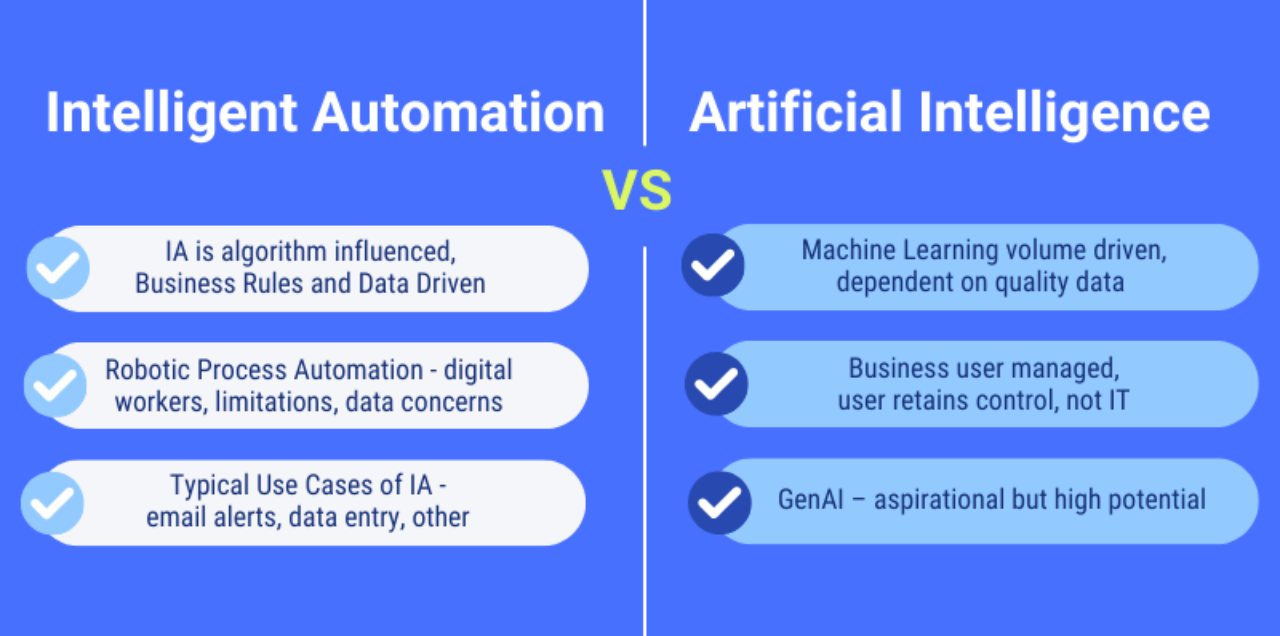
CRE servicing operations are integrating both AI and IA to varying degrees. IA is commonly used for automating routine tasks, freeing up staff to focus on higher-value activities. AI is increasingly being leveraged to analyze large datasets, extract insights, and improve decision-making processes.
Goldman Sachs estimated in 2025 that AI tools could reduce CRE due diligence costs by 20% to 35% for large institutional portfolios. In servicing specifically, the savings concentrate in three areas:
"Companies investing early in strong data platforms are now leading the way. A robust data foundation is essential for growth, and organizations preparing for advanced AI applications will continue to gain momentum and stay ahead of the competition." — Yao Morin, CTO, JLL (JLL 2025 Global Real Estate Technology Survey)
The challenges discussed at the conference still apply, sharpened by enforcement.
Smart Capital Center is an AI-powered underwriting, portfolio insight, and debt management platform used by KeyBank, JLL, RGA, Pacific Life, The RMR Group, and other leading institutional investors and lenders. The platform was named a GlobeSt Influencer in CRE Technology in both 2024 and 2026.
For CRE servicers, the platform delivers:
For a deeper look, see our recap of MBA CREF 2024 takeaways and our two-part series on the future role of generative AI in CRE lending.

What is the difference between AI and intelligent automation in CRE servicing?
Intelligent automation (IA) uses rule-based logic to automate repetitive, structured tasks like payment processing, report generation, and workflow routing. Artificial intelligence (AI) handles unstructured tasks that require learning, language understanding, or probabilistic decision-making — such as classifying nonstandard documents, evaluating risk patterns, and generating narrative content. In production CRE servicing, AI and IA are layered: IA runs the deterministic spine of the workflow while AI handles the judgment-adjacent work.
How much can automation reduce CRE servicing costs?
According to Goldman Sachs (2025), AI tools can reduce CRE due diligence costs by 20% to 35% for large institutional portfolios. Savings concentrate in analyst hours spent on data ingestion (historically 40–60% of effort), quality-control review, and exception handling. EY (2026) reports that agentic AI can reduce manual AML and KYC investigation time by 50%.
What are the biggest risks in deploying AI and IA in CRE loan servicing?
The five primary risks are reliability (model hallucinations on financial data), data privacy (borrower and tenant information), bias (fair-lending compliance), cost (integration and ongoing infrastructure), and regulation. The EU AI Act entered full enforcement for high-risk AI in financial services in August 2026, and U.S. regulators (OCC, FDIC, CFPB) have issued model-risk guidance specific to AI. Mature platforms address these through retrieval-augmented generation, private model instances, bias auditing, and structured human-in-the-loop review.
Will AI replace human servicers and asset managers?
No. AI and IA replace data-processing and document-handling tasks, but credit judgment, structuring decisions, exception adjudication, and borrower relationships remain human work. The pattern emerging in 2026 is hybrid teams: automation handles ingestion, normalization, modeling, and first-draft documentation; humans focus on judgment-intensive decisions and client relationships.
What does the EU AI Act mean for U.S. CRE servicers?
The EU AI Act entered full enforcement for high-risk AI systems in financial services in August 2026. U.S. servicers operating in EU jurisdictions or serving EU-based borrowers must comply directly. Even servicers with no EU exposure face equivalent pressure, as U.S. regulators (OCC, FDIC, CFPB) have issued AI model-risk guidance modeled on similar principles: explainability, bias auditing, and documented human oversight.
How does Smart Capital Center help CRE servicers operationalize AI and IA?
Smart Capital Center provides production-ready AI and IA for CRE underwriting, covenant monitoring, portfolio insight, and debt management — already integrated with the data sources, document formats, and reporting systems used by institutional servicers. The platform analyzes 1B+ real-time data points across 120M+ properties, has supported $500B+ in CRE transactions, and integrates with Yardi, ARGUS, SS&C Precision, and Midland Enterprise via API. Book a demo to see it applied to your servicing portfolio.

Move faster. Service smarter. Outperform at scale. Smart Capital Center turns fragmented loan and portfolio data into faster servicing, sharper risk insight, and lower operational costs. Book a demo today.
Or contact us at demo@smartcapital.center to request a copy of our AI and Intelligent Automation in CRE Servicing brochure.