

Smart Capital News

July 30, 2026
Smart Capital News
July 30, 2026
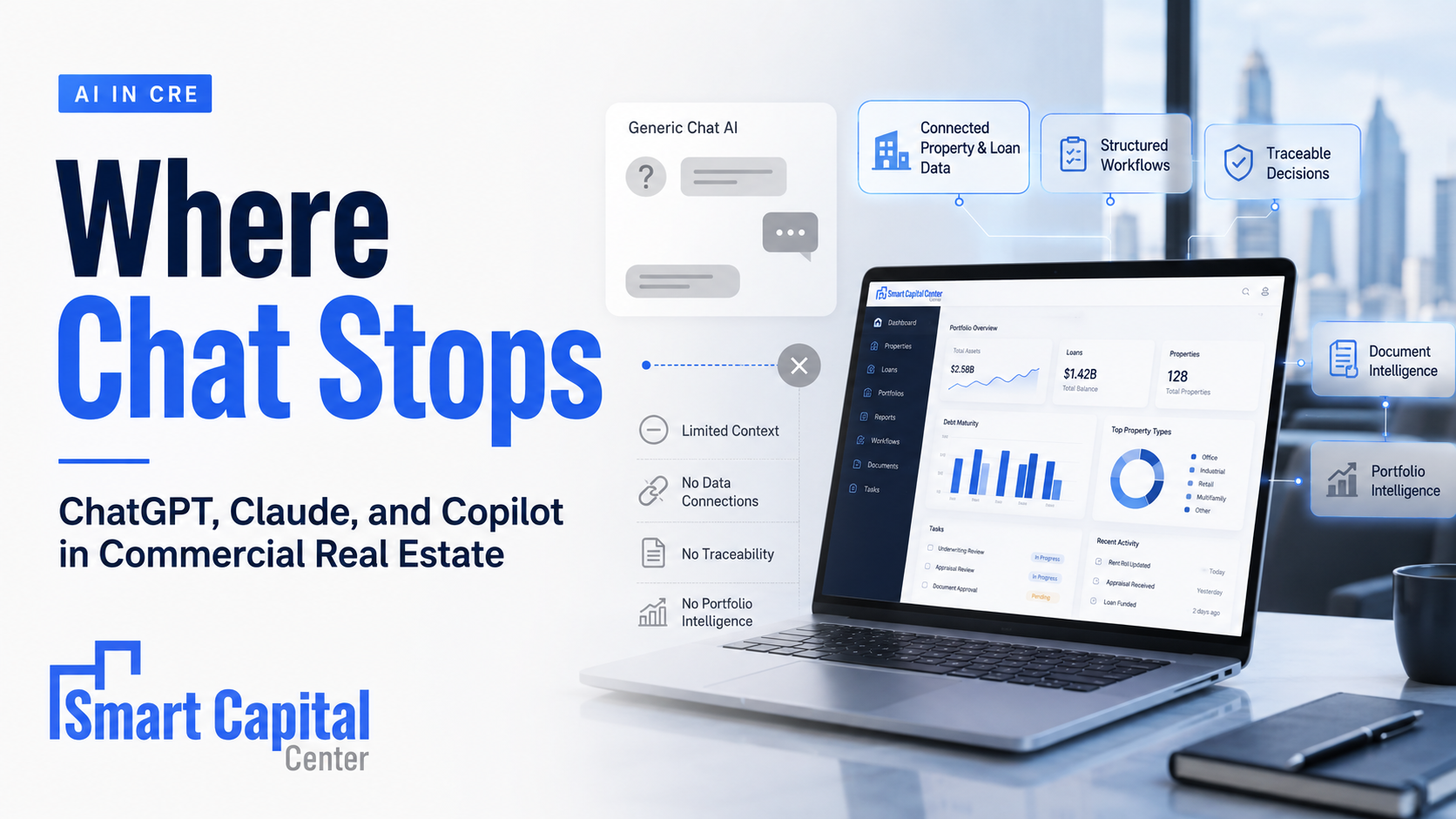
This article is written for CFOs, COOs, and senior finance and operations leaders in commercial real estate. It is especially relevant for private equity firms, developers, and owner-operators seeking to improve efficiency, manage risk with confidence, and scale decision-making through AI-powered underwriting, portfolio intelligence, and automated reporting.
According to Deloitte’s 2025 Commercial Real Estate Outlook, 76% of CRE firms are still researching or piloting AI — only 24% have moved past those stages into production. Yet 88% of global CRE leaders expect their company’s revenues to increase in 2025, and 81% identify data and technology as their top spending priority. The pressure on CFOs and COOs is structural: the firms with AI fully in production now prioritize financial planning and analysis (43%) above any other workload, ahead of risk management (37%) and property operations (35%). The order matters — it tracks the order in which competitive advantage is being banked.
Add the maturity wall to the picture. MMG Real Estate Advisors reports nearly $1.0 trillion in CRE loans matured in 2025 alone, with well over $1.5 trillion reaching maturity by the end of 2026 — multifamily maturities alone jump 56% year-over-year to $162.1 billion in 2026. CFOs and COOs steering CRE organizations through this refinancing wave cannot afford reporting infrastructure that runs on a 5–7 day cycle while the market moves daily.
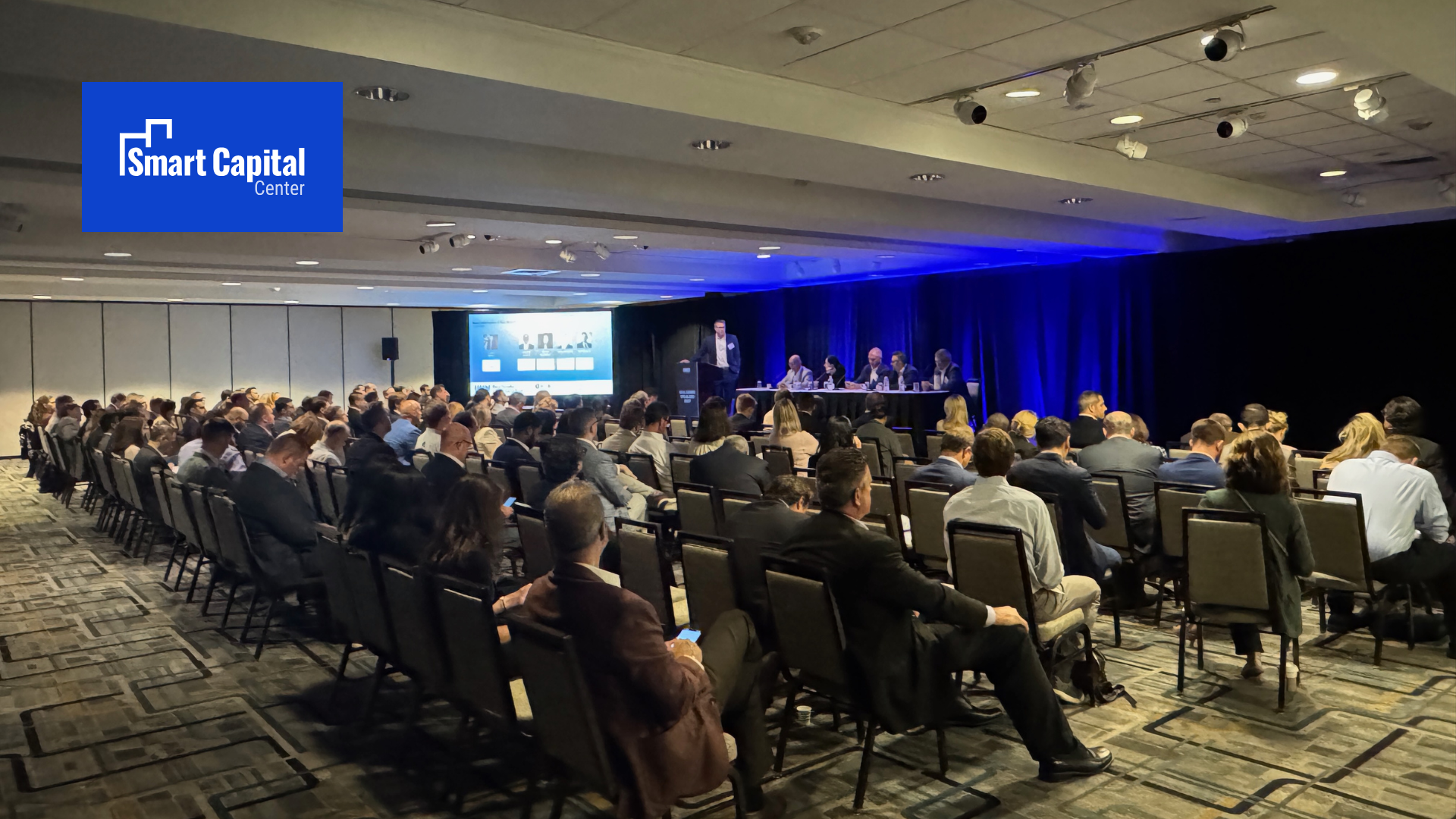
That is the context in which the IMN COO & CFO Forum convened the decision-makers who keep CRE organizations running. With more than 30% of the audience made up of CFOs and COOs — the rest funds, owner-operators, and developers — this year’s sessions reflected a growing consensus: the future of CRE finance will be written with AI at the center. Smart Capital Center — the AI-powered CRE intelligence platform with $500B+ in analyzed transactions, 120M+ properties, 1B+ real-time data points, and institutional clients including KeyBank, JLL, RMR Group, Tremont Realty Capital, and Community Preservation Corporation — was on hand to anchor the AI conversation.
Several executives reflected on how transaction cycles have become increasingly complex. As one put it:
“I’ve been in CRE nearly two decades, and the way deal flow is managed has barely changed. We emphasize technologically managing the transactional lifecycle for a more efficient and more agreeable future.”
“I’ve been in CRE nearly two decades, and the way deal flow is managed has barely changed. We emphasize technologically managing the transactional lifecycle for a more efficient and more agreeable future.” — CFO panelist, IMN COO & CFO Forum
Smart Capital Center streamlines every stage of the transaction lifecycle
For CFOs and COOs, the transaction lifecycle has traditionally been slowed by fragmented systems, siloed data, and manual reporting. Underwriting could take weeks, often relied on inconsistent inputs, and portfolio monitoring was reactive rather than predictive. These inefficiencies create bottlenecks at precisely the moments when speed and precision are most critical — deal close, refinancing, covenant review.
Smart Capital Center eliminates those frictions with an AI-powered platform that digitizes and connects the entire CRE investment lifecycle — from deal origination through underwriting, portfolio management, and divestiture. A platform comparison is detailed in our review of CRE underwriting and automation platforms.
Four lifecycle stages, one integrated system:
• Origination and dealflow. Automated screening of incoming opportunities, due-diligence document analysis, and investment memo generation in minutes — giving leaders faster visibility into risk and return, and eliminating the missed-opportunity cost of slow data.
• Underwriting. Extraction, structuring, and analysis of financial data from rent rolls, leases, T-12s, financial statements, and offering memorandums. AI analysts surface anomalies, benchmark assumptions against 1B+ real-time data points, and deliver source-linked insights in minutes — work that previously took 30–40 minutes per financial statement now completes in 1–3 minutes (per Fernando Salazar, JLL).
• Portfolio management. Real-time monitoring of asset performance, tenant risk, and debt obligations. Stress tests run instantly across thousands of scenarios to model exposure to interest rates, vacancies, and refinancing cliffs.
• Investor and stakeholder reporting. Automated investment memos, asset summary reports, lender packages, credit memos, and covenant monitoring — produced in minutes with version control and full audit traceability built in.
“Transaction lifecycles can feel like repeating the same process fifteen times. AI can expedite data collection, communication with investors and tenants, acquisitions, and divestitures — making CRE transactions easier, faster, and less costly.” — CFO panelist, IMN COO & CFO Forum
“AI allows us to expedite data collection, streamline communications with tenants and investors, and simplify acquisitions and divestitures. It makes transactions easier and faster.”
“We’re already using AI agents in underwriting and asset management. They generate valuations, support financing conversations, and ensure we meet criteria faster. AI helps us make decisions with greater confidence.”
During discussions on operations, one contributor framed the shift in concrete terms:
“We’ve used AI agents for our underwriting and asset managers by providing information, generating automated valuations, and assisting in conversations about financing. This is bringing much more confidence into decision-making.” — COO panelist, IMN COO & CFO Forum
In other words, AI is helping financial leaders move from static, after-the-fact reporting toward live intelligence — tools that don’t just describe what happened but illuminate what is happening now. Per the JLL Global Real Estate Technology Survey, 85% of real estate organizations still struggle to generate accurate, real-time information — the foundation every financial decision depends on.
Smart Capital Center enables live intelligence for CFOs and COOs
Static, after-the-fact reporting leaves leaders reacting too late to act with confidence. The platform delivers always-on, live intelligence by integrating 1B+ real-time market signals and 120M+ property records into one connected system.
• Real-time updates. Rent rolls, financials, and operating data refresh continuously, giving leaders a current view of their portfolios — not a quarterly snapshot.
• AI research agents. Surface anomalies in financials, identify NOI optimization opportunities, and connect tenant performance with external market signals (CoStar, JLL Research, CBRE Research, Yardi Matrix, Federal Reserve H.8 and H.15 data).
• Visual intelligence. Drill instantly into property-level or loan-level dashboards, generate visualizations on demand, and align teams on one source of truth — not seven versions of the same spreadsheet.
For CFOs and COOs, this eliminates the blind spots between reporting cycles and replaces lagging data with actionable insight at the speed of the market.
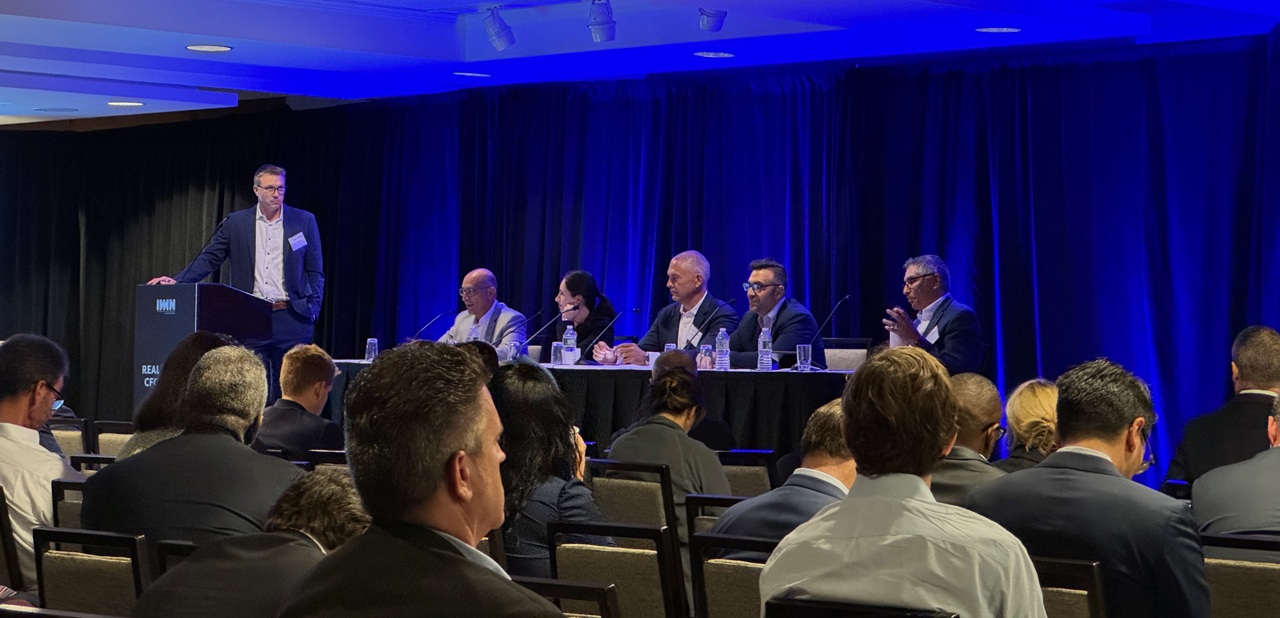
When the conversation turned to portfolio management, many agreed that stress testing is now a top priority — unsurprising given that more than $1.5 trillion in CRE loans reaches maturity by end-2026, with multifamily maturities alone jumping 56% to $162.1 billion in 2026.
“We’re finding enormous value in stress-testing portfolios with millions of scenarios. It gives leadership visibility into downside protection and shows us five or more ways to improve our portfolio’s quality.” — CFO panelist, IMN COO & CFO Forum
“The ability to run millions of scenarios quickly is a game-changer. We can measure downside risk, build in protections, and identify ways to improve portfolio quality after a stress test. It gives leadership more clarity around risk exposure.”
“Technology is critical here. Managing the lifecycle of a portfolio requires tools that can handle the scale and complexity of today’s market. AI is what makes that future possible.”
Traditional stress testing and reporting rely on Excel models and static assumptions — far too slow for today’s volatility. Smart Capital Center replaces this with automated, AI-powered monitoring that gives CFOs and COOs a live, enterprise-wide view of portfolio health.
With Smart Capital, finance leaders move from lagging oversight to proactive intelligence through:
“The role of CRE finance leaders is shifting from reporting on what happened to anticipating what’s next — and AI is the engine making that shift possible.” – Laura Krashakova, CEO, Smart Capital Center
The result: risk management becomes risk intelligence, giving executives the clarity and confidence to act at the speed of the market.
Efficiency was another refrain that surfaced repeatedly. One executive admitted: “Efficiency is everything. If we can streamline processes, we can place more capital and do it faster. That’s the real value — reducing friction in operations so we can focus on growth.”
“By streamlining processes, we can deploy more capital and do it faster. Efficiency translates directly into growth.”
“Efficiency isn’t just about speed. It’s also about quality. By combining stress testing with efficiency improvements, we ensure capital is being deployed in ways that are resilient under different market conditions.”
Efficiency in CRE finance is about more than speed; it’s about precision and confidence in deploying capital. Smart Capital Center’s automation reduces cycle times from weeks to hours, freeing teams to focus on higher-value work.
For CFOs and COOs, this means faster deployment of capital, fewer missed opportunities, and growth at scale without increasing headcount.

From the COO perspective, the daily grind remains heavy. As one participant explained:
“The data struggle is constant. Every deal requires reconciling inputs from property managers, leasing teams, lenders, and investors. The real challenge is consolidating all that into insights we can actually use.” — COO panelist, IMN COO & CFO Forum
“Data overwhelm is the biggest challenge. Every deal involves inputs from property managers, lenders, investors, and tenants. The real struggle is consolidating all of that into actionable insights we can trust — and doing it quickly enough to drive confident decisions.”
“That’s where AI comes in. By aggregating information, generating valuations, and assisting with financing, AI provides the clarity we need to make confident decisions.”
The “data struggle” COOs described at the forum — consolidating inputs from property managers, tenants, lenders, and investors — is where Smart Capital Center provides relief
For operational leaders, this means turning hours of manual consolidation into minutes, and shifting focus from chasing data to driving strategy.
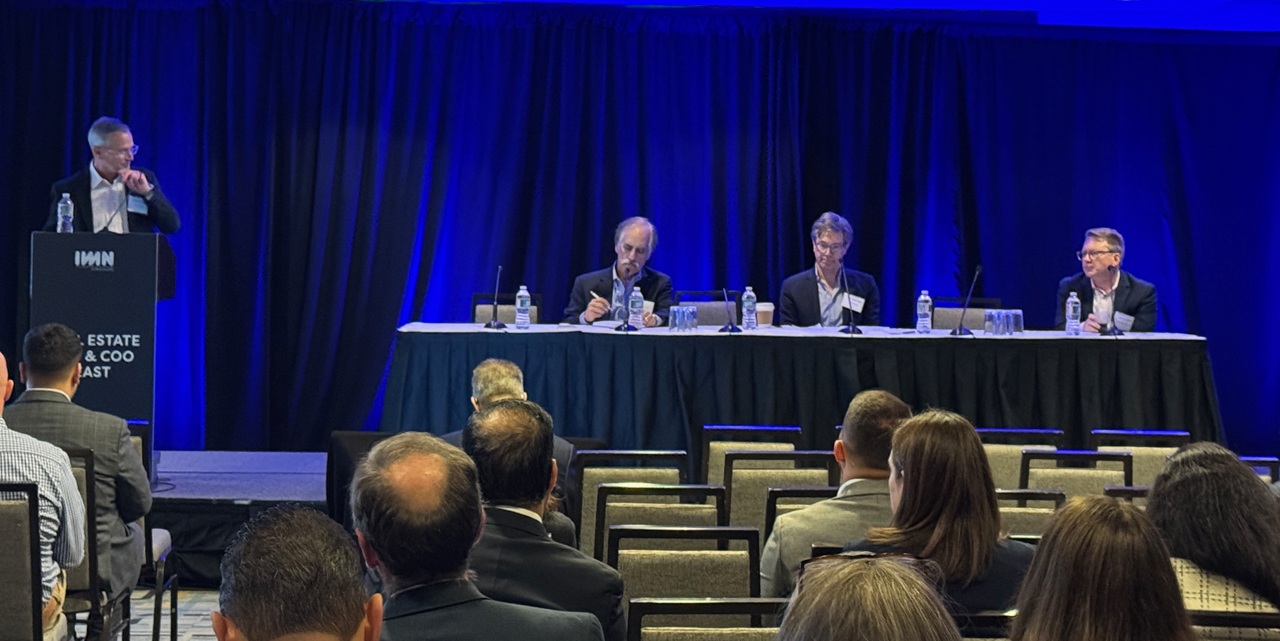
Toward the close of the forum, participants spoke about the bigger vision:
“Connectivity in transaction lifecycles, tenant experiences, and investor communications is what makes organizations easier and faster to run. AI is the glue that connects it all.” — CFO panelist, IMN COO & CFO Forum
AI is more than a tool for automating one-off tasks. It is becoming the connective tissue of CRE organizations — linking tenants to owners, assets to portfolios, and data to strategy. Per McKinsey’s 2025 framework for agentic AI in real estate, the most successful deployments separate “steps” (repeatable tasks suited to AI execution) from “thoughts” (judgment calls that preserve human discretion). McKinsey estimates this human-plus-agent operating model could unlock $430–$550 billion in annual global value across real estate, construction, and development. For CFOs and COOs running these organizations at scale, the opportunity is harnessing AI not as a siloed application but as an enterprise-wide intelligence layer.
AI is not just a tool for siloed tasks — it is the connective tissue of modern CRE organizations. The platform enables that connectivity across the enterprise:
• Integration with core systems. Direct integration with ARGUS Enterprise, Yardi, SS&C Precision, Midland Enterprise, Microsoft Excel, and any system via API.
• Cross-lifecycle visibility. Data from underwriting informs portfolio management; stress testing supports investor reporting; origination insights flow through to asset management.
• Scalable infrastructure. As portfolios grow and diversify, the platform scales with them — eliminating bottlenecks and preserving speed to market.
• Seamless flow of information across acquisitions, financing, portfolio management, and investor reporting.
• Enterprise visibility that allows leadership to make confident, data-backed decisions in real time.
• Reduced silos by connecting stakeholders at every stage of the CRE lifecycle, from tenants and property managers to lenders and capital partners.
By embedding AI and automation into every process, Smart Capital Center transforms disconnected functions into a unified, enterprise-wide intelligence network.
The IMN COO & CFO Forum confirmed what the data already shows: the CRE market is entering a phase where AI-enabled intelligence defines competitive advantage. With the maturity wall reshaping the financing landscape and 88% of CRE leaders expecting revenue growth despite that pressure, the firms with AI in production will out-execute those still piloting.
Smart Capital Center strengths highlighted at the forum:
• AI in the CRE transaction lifecycle. From underwriting to portfolio management to divestiture, the platform automates workflows that once consumed months of manual effort.
• Live intelligence. Real-time monitoring and automated insights give CFOs and COOs the clarity to act decisively — closing the 85% real-time-information gap JLL identified.
• Risk intelligence. Portfolio stress testing and downside protection tools prepare organizations for the volatility built into the $1.5T+ maturity wave.
• AI agents and analysts. Embedded into workflows, AI agents work alongside teams to accelerate underwriting, enhance reporting, and drive operational efficiency at portfolio scale.
“We emphasize technologically managing the transactional lifecycle for a more efficient future.” — CFO panelist, IMN COO & CFO Forum
That future is already arriving — and the firms positioned to capture it are the ones with AI infrastructure in production today, not the ones still in pilot.
The CFOs and COOs who gathered at IMN came with questions about risk, efficiency, and opportunity. They left with clarity: AI is no longer an experiment — it is the path forward for CRE organizations seeking resilience and growth.
Three diagnostic questions every CRE finance leader should answer this quarter:
1. How long does your team take to produce a quarterly variance commentary across the full portfolio? If the answer is more than 48 hours, your reporting infrastructure is now a competitive disadvantage.
2. How many external data sources are reconciled in your standard underwriting and stress-test workflows? If fewer than 10, you are deploying capital without context.
3. Can your committee or investor query a portfolio-level question and receive a data-backed answer in the same meeting? If not, your decision velocity is structurally constrained — and the maturity wall does not pause for slow analysis.
For leaders stewarding billions in assets, the choice is direct: continue wrestling with fragmented data and reactive decision-making, or operate with AI-driven intelligence that enables faster, smarter, more confident decisions. The IMN Forum was clear about which side of that line is winning.
How are CRE CFOs using AI in 2025?
CRE CFOs are deploying AI across four primary workloads: (1) underwriting and financial-statement processing (30x productivity gain reported by JLL); (2) portfolio stress testing and scenario modeling against thousands of downside cases; (3) covenant and debt management with real-time DSCR/LTV monitoring; and (4) automated investor and stakeholder reporting. Per Deloitte’s 2025 outlook, financial planning and analysis is the #1 priority workload (43%) for CRE firms with AI fully in production — above risk management (37%) and property operations (35%).
How does AI help CRE finance teams handle the 2025–2026 maturity wall?
With more than $1.5 trillion in CRE loans maturing through end-2026 — including a 56% jump in multifamily maturities to $162.1 billion in 2026 — finance teams need real-time visibility into refinancing risk, covenant headroom, and portfolio exposure under multiple rate scenarios. AI-powered platforms like Smart Capital Center continuously monitor DSCR, LTV, and loan maturity calendars across the portfolio, run stress tests against thousands of rate and occupancy scenarios in seconds, and surface refinancing risk 12–18 months before maturity. The alternative — quarterly Excel-based reviews — leaves teams reacting to problems already on the balance sheet.
What is the ROI of AI for CRE finance and operations teams?
Measurable, named-source results across institutional clients: JLL achieved 30x faster financial-statement processing (30–40 minutes per statement compressed to 1–3 minutes); KeyBank reached 40% reduction in financial model prep time on its CRE lending workflow; RMR Group compressed underwriting cycles enough to redirect analyst capacity from manual reconciliation to portfolio strategy. Portfolio reporting cycles drop from 5–7 business days to under 24 hours. The hard ROI compounds because AI extends analyst capacity rather than replacing it — firms deploy more capital and run more scenarios without expanding headcount.
Can Smart Capital Center integrate with my existing CRE finance and accounting stack?
Yes. The platform integrates directly with ARGUS Enterprise, Yardi, Midland Enterprise, SS&C Precision, Microsoft Excel, and any other system via API. Existing models, templates, and chart-of-accounts mappings are preserved — the platform layers on top of the current stack rather than replacing it. Data flows in both directions, so analysts export AI-generated outputs back into preferred reporting templates without disruption.
How do CRE CFOs maintain audit and committee defensibility when using AI?
By insisting on full source-link traceability on every AI output. On Smart Capital Center, every commentary line, every risk flag, every stress-test assumption links back to its underlying data source — from the rent roll line item to the inspection-report finding to the market data feed. The platform holds SOC 2 Type 2 and ISAE-3000 compliance with regular independent audits. The platform is in production at regulated entities including KeyBank and Aareal Bank, where FFIEC and SOX compliance are non-negotiable. CFOs preserve audit, committee, and LP defensibility while gaining workflow speed.
Will AI replace CFO, COO, or CRE finance team roles?
No. AI removes the data-reconciliation, first-draft commentary, and manual-modeling layers that consume most analyst time, but the CFO, COO, and analyst still own interpretation, exception handling, and committee-grade judgment calls. Per McKinsey’s 2025 analysis on agentic AI in real estate, the most successful deployments separate “steps” (repeatable tasks suited to AI execution) from “thoughts” (judgment calls requiring human discretion). Teams using Smart Capital Center reallocate analyst capacity to deal screening, portfolio strategy, and investor relations — not headcount reduction. Finance leaders shift from reporting on what happened to anticipating what is next.
How fast can a CRE finance team see results from AI adoption?
Within the first reporting cycle. KeyBank reports 40% reduction in financial model prep time inside its CRE lending workflow; JLL reports 30x productivity gain in financial-statement processing; RMR Group reports compressed underwriting cycles inside the first quarter of deployment. Portfolio-level benefits compound from there: faster underwriting feeds faster capital deployment, which feeds stronger pipeline coverage, which feeds higher analyst productivity. The full ROI typically materializes within two reporting cycles — not the multi-year horizon associated with build-it-yourself enterprise IT.
Get started with Smart Capital Center: Book a demo today to see how AI-powered CRE finance, operations, and portfolio intelligence apply to your firm.