

AI in Commercial Real Estate

July 30, 2026
AI in Commercial Real Estate
July 30, 2026

In commercial real estate, time is money — and most of it leaks out of underwriting, asset monitoring, and risk detection workflows that still depend on spreadsheets and stale dashboards. The opportunity is now clear in the data. According to JLL's 2025 Global Real Estate Technology Survey, 88% of CRE investors and operators have started piloting AI, but only 5% report achieving all of their stated AI goals. The gap between piloting and operating is now where competitive advantage is decided.
Today we're introducing Smart Capital Center's AI Agent capabilities — an industry-first leap toward intelligent automation that transforms how CRE investors, lenders, and asset managers interact with data. More than just a tool, our agents act as always-on collaborators — monitoring data streams, flagging risk, identifying opportunities, and accelerating workflows. Welcome to your AI workforce.
Smart Capital Center's AI agents aren't reactive bots waiting for queries. They proactively comb through portfolio data in real time, surfacing what matters most:
These agents are built atop the industry's most comprehensive CRE data lake — spanning over 120 million properties and more than 1 billion hyperlocal market signals. That means your AI collaborators are not just fast — they're deeply contextual, CRE-aware, and always learning.

Traditional CRE systems rely on human-led workflows: manual modeling, spreadsheet-driven decision-making, and dashboards that go stale the moment they're built. CRE has evolved — and the systems powering it must evolve too.
The pressure point is real. According to the Deloitte 2026 Commercial Real Estate Outlook — a survey of 850+ C-suite executives at CRE firms with $250M+ AUM across 13 countries — more than 60% of CRE firms still rely on legacy technology infrastructure, and 27% are actively struggling with AI implementation due to technical issues, lack of expertise, or organizational resistance. Yet 72% of global real estate owners plan to invest in AI-enabled solutions, and 81% rank data and technology as their top spending priority.
The market is bifurcating: firms that operationalize AI inside their workflows are pulling ahead, while pilot-only firms get left behind.
Smart Capital Center's AI agents eliminate the inefficiencies blocking that operationalization by:
They aren't just better dashboards. They are your 24/7 analysts, asset managers, and capital markets pros — scaling your capacity without increasing your headcount.
Smart Capital's AI analysts and assistants are built not to replace the expertise of real estate professionals — but to multiply it. They handle repetitive tasks so your team can focus on what humans do best: strategy, judgment, and relationships.
This pattern is now backed by primary research. The Harvard Business School / BCG / MIT / Wharton / Warwick study Navigating the Jagged Technological Frontier, based on 758 BCG consultants across 18 realistic tasks, found that workers using GPT-4 completed 12.2% more tasks, worked 25.1% faster, and produced output rated 40% higher in qualitythan the control group. The lowest-performing consultants gained the most — a 43% improvement versus 17% for top performers — meaning AI compresses the productivity gap inside teams.
For CRE, the same pattern translates directly:
No more waiting. No more digging. No more missed opportunities.
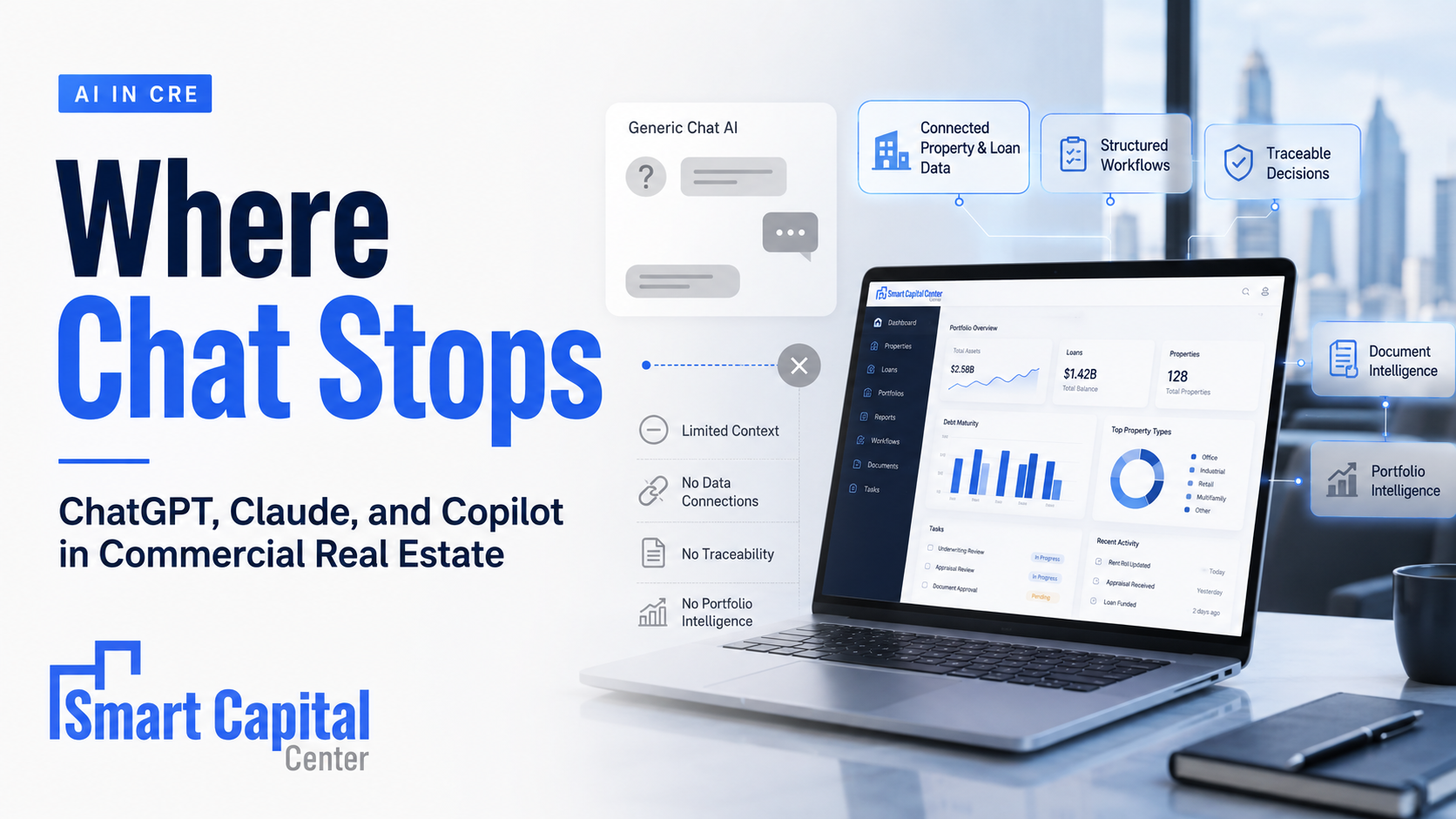
Unlike generic chatbots or bolt-on AI analytics, our agents are fully embedded within a vertically integrated CRE platform.
Our agents are trained on deep CRE logic — every lease term, rent roll anomaly, cap rate deviation, and debt covenant nuance. They're not guessing — they're reasoning. This matters because, as the Deloitte 2026 outlook notes, the share of CRE leaders reporting "transformative impact" from AI dropped from 12% to just 1% year over year — not because the technology failed, but because most firms deployed generic AI without sector-specific data architecture.
Agents don't wait for you to ask. They proactively alert you when something is off — whether it's a tenant risk in a rent roll, a missed loan covenant, or a rare deal that matches your target criteria. According to McKinsey's 2026 analysis of agentic AI in real estate, the shift from generative to agentic AI represents the difference between "help me understand" and "help me get it done" — and could unlock $430–$550 billion in annual value across real estate, construction, and development globally.
From origination to servicing, every data point is tracked, structured, and analyzed in a single unified system — automatically. This gives our agents the full context behind your assets, markets, and strategy. Native connections to Yardi, ARGUS, SS&C Precision, Midland Enterprise, and any system via API.
Commercial real estate leaders are already seeing dramatic efficiency gains:
"Companies investing early in strong data platforms are now leading the way. A robust data foundation is essential for growth, and organizations preparing for advanced AI applications will continue to gain momentum and stay ahead of the competition." — Yao Morin, CTO, JLL (JLL 2025 Global Real Estate Technology Survey)
When AI takes care of the groundwork, humans can focus on high-value strategy.

Generative AI is fundamentally reshaping knowledge work — and CRE is no exception. CBRE has invested heavily in tech-forward underwriting systems. Blackstone is integrating AI into property risk evaluation. Even small to midsize investment firms are realizing they can't compete without automated insight.
The market data confirms it. The AI in real estate market was valued at approximately $2.9 billion in 2024 and is projected to reach $41.5 billion by 2033, growing at a compound annual rate above 30%. McKinsey estimates AI can generate between $110 billion and $180 billion in value for the global real estate sector, concentrated in property valuation, operational management, marketing, and demand forecasting.
In this fast-moving environment, Smart Capital Center is leading the way — not just with faster data processing, but with actionable AI that understands CRE deeply and acts like a seasoned professional. The platform was named a GlobeSt Influencer in CRE Technology in both 2024 and 2026.
The launch marks a turning point in how CRE teams scale, compete, and win.
Our AI agents are currently rolling out in beta with select customers, offering real-time support for:
And this is only the beginning. Over the coming months, we'll be expanding capabilities across the full investment lifecycle — from acquisition through exit — with agents that grow smarter over time.
In a high-rate, uncertain market environment, efficiency is everything. Deals are fewer, diligence is deeper, and timelines are tighter. CRE professionals need every edge they can get.
The regulatory environment is also hardening. The EU AI Act entered full enforcement for high-risk AI systems in financial services in August 2026, and U.S. regulators (OCC, FDIC, CFPB) have issued model-risk guidance specific to AI. Compliance posture is now a competitive variable, not a checkbox — which favors purpose-built CRE platforms over bolted-on chatbots.
With Smart Capital's AI workforce, teams can:
At Smart Capital Center, we believe the future of CRE investing is faster, smarter, and driven by collaboration between humans and machines. With our AI agents, you don't just keep up — you lead.
It's time to stop managing data and start commanding it.
Get started with your AI workforce now.
What is an AI agent in commercial real estate?
An AI agent in CRE is an autonomous software system that orchestrates multi-step workflows across underwriting, asset monitoring, and portfolio management without requiring a human prompt at each step. Unlike generative AI tools that respond to single queries, AI agents continuously ingest data, flag anomalies, run covenant checks, and route exceptions to humans only when judgment is required. According to McKinsey, the shift to agentic AI could unlock $430–$550 billion in annual value across real estate, construction, and development.
How is Smart Capital Center's AI different from generic AI tools?
Smart Capital Center's AI agents are CRE-native — trained on lease terms, rent roll patterns, cap rate logic, and debt covenant structures — and embedded within a vertically integrated platform spanning 120M+ properties and 1B+ market signals. Generic chatbots and bolt-on analytics lack this domain context. According to the Deloitte 2026 CRE Outlook, the share of CRE leaders reporting "transformative impact" from AI dropped from 12% to just 1% year over year — primarily because most firms deployed generic AI without sector-specific architecture.
What productivity gains have CRE teams seen using Smart Capital Center?
JLL reported a 30x productivity boost, with a single financial statement going from 30–40 minutes of analyst time to 1–3 minutes. KeyBank achieved a 40% reduction in time to build financial models. These gains are consistent with the broader Harvard / BCG study finding that knowledge workers using AI complete 12.2% more tasks, 25.1% faster, with 40% higher quality output.
What CRE workflows can AI agents handle today?
Smart Capital Center's AI agents currently support deal screening and underwriting, financial model generation, risk and opportunity alerts, debt monitoring and capital markets support, and portfolio-level analytics and reporting. The roadmap expands to cover the full investment lifecycle from acquisition through exit.
Will AI agents replace human CRE professionals?
No. AI agents replace data-processing and document-handling tasks, but credit judgment, structuring, and borrower relationships remain human work. The pattern emerging in 2026 is hybrid teams: AI handles ingestion, normalization, modeling, and first-draft documentation; humans focus on judgment-intensive decisions, exceptions, and client relationships.
How do regulatory frameworks like the EU AI Act affect CRE AI deployments?
The EU AI Act entered full enforcement for high-risk AI systems in financial services in August 2026, formalizing requirements for explainability, bias auditing, and human-in-the-loop oversight. U.S. regulators (OCC, FDIC, CFPB) have issued similar model-risk guidance. CRE platforms must now demonstrate explainability and structured human oversight — which favors purpose-built systems over generic AI bolt-ons.
How do I get started with Smart Capital Center's AI agents?
Smart Capital Center's AI agents are currently rolling out in beta with select customers. To deploy them on your portfolio, book a demo or contact us at demo@smartcapital.center.