

Smart Capital News

July 30, 2026
Smart Capital News
July 30, 2026

According to Deloitte’s 2025 Commercial Real Estate Outlook, 76% of CRE firms are still researching, piloting, or in early-stage AI implementation — and 81% of global CRE leaders identify data and technology as the area where they most need to direct spending. The window between experimentation and competitive disadvantage is closing fast. McKinsey’s 2024 analysis estimates generative AI alone could unlock $110–$180 billion in value across the global real estate industry; its 2025 follow-up on agentic AI puts the broader value pool at $430–$550 billion annually.
That is the context in which Smart Capital Center’s CEO, Laura Krashakova, joined Trimont — the largest independent commercial real estate loan servicer in the United States, with $700B+ in loans under management and roughly 11% of the U.S. CRE lending market — for the firm’s quarterly fireside chat. The discussion was not about distant possibilities. It was about how AI is already reshaping CRE servicing and asset management, and why the firms that adapt now will be the ones still standing five years from today.
Trimont’s Beau Jones, Executive Managing Director of Global Business Development, set the tone: client expectations have accelerated. What was once seen as innovation is now the baseline. Together, Jones and Krashakova explored where AI is driving measurable value in CRE, the cultural and operational hurdles to adoption, and how Smart Capital Center — the AI-powered CRE intelligence platform with $500B+ in analyzed transactions, 120M+ properties in its database, and institutional clients including KeyBank, JLL, RMR Group, and Tremont Realty Capital — is helping firms move from experimentation to embedded transformation.
With that context, here are the questions CRE teams are asking—and the answers from Trimont and Smart Capital Center.
Laura Krashakova (Smart Capital Center): “Last year’s miracle is table stakes today. Lenders and equity owners now want AI agents as teammates—monitoring portfolios, flagging risks, and triggering workflows in real time, and we at Smart Capital Center have been heads down building it for our customers.”
Beau Jones (Trimont): “Our Triview portfolio analytics wowed clients five years ago. Today they want continuous updates and instant context—and they expect changes within a week. I used a chatbot recently to generate a full page with code in minutes. It only needed a final 5% human touch.”
Krashakova: “Underwriting. Per Deloitte’s 2025 outlook, financial planning and analysis is now the #1 priority area (43% of respondents) for CRE firms with AI in production. Automating data ingestion from documents into DCFs is baseline; the real step-change is deep research — AI scanning tenant health, local news, financial variances, and market signals to surface risks and assumptions with commentary. Analysts step up to review, validate, and decide.”
Krashakova: “Data quality still matters, but the bigger barrier is change management. Build a culture where people think AI first. We run demos, hold office hours, and require engineers to note how AI was (or wasn’t) used on each ticket—so the default question becomes: Can AI help here?”
Krashakova: “Balance enablement with guardrails: limit sensitive data to external systems, keep human-in-the-loop review for ownership, and design workflows to be as deterministic as possible to reduce prompt-injection risk. Newer protocols (like MCP) are promising but should be tested internally before exposure.”
From this conversation, eight themes emerged that will shape CRE over the next five years — each grounded in specific, measurable shifts already underway across institutional lenders, servicers, and asset managers. Per the JLL Global Real Estate Technology Survey, 85% of real estate organizations still struggle to generate accurate, real-time information. The takeaways below address exactly that gap.
Five years ago, Trimont’s Triview platform — a client-facing portfolio analytics tool — was seen as groundbreaking. Today, clients want more. They expect systems that not only deliver insights but also monitor portfolios continuously, flag risks, and initiate workflows automatically.
“Last year’s miracle is table stakes today. Lenders and equity owners now want AI agents to function like teammates — always on, constantly watching, and capable of taking the first step toward resolution. Smart Capital Center’s team has been heads down building our Smarty Assistant and underwriting and surveillance agents.” — Laura Krashakova, CEO, Smart Capital Center
Jones confirmed the shift from his vantage point: “When we first showed Triview, it was a wow factor. Now clients say, ‘I like it — but can it do more, and can you update it next week?’ Expectations are accelerating.”
This new baseline is where Smart Capital Center positions itself: embedding AI directly into workflows so insights are paired with next-step actions. Across the platform’s institutional customer base — including KeyBank, JLL, RMR Group, and Community Preservation Corporation — reporting cycles that used to run 5–7 business days now complete in under 24 hours. KeyBank specifically has reported a 40% reduction in financial model prep time on its CRE lending workflow.
Both leaders agreed that AI adoption isn’t a single leap — it’s a staged process:
1. Experimentation with generic tools. Firms begin with ChatGPT or copilots, using them to summarize documents or draft emails. Useful, but surface-level.
2. Fine-tuning with context. The next step is layering organizational data into those tools, improving relevance and uncovering the workflows where AI makes the biggest impact.
3. Deeply embedded, workflow-specific solutions. True transformation comes when AI is customized for underwriting, servicing, or asset management — connected to the right data and designed to act, not just report.
“Most of CRE is still in the first two stages,” Krashakova noted. “But the real gains come at stage three. That’s where firms stop experimenting and start scaling.” Per Deloitte’s 2025 outlook, only 24% of CRE firms have moved past research or pilot — meaning roughly three out of four firms are still operating in stages one or two. That’s the gap competitive firms are closing now.
Smart Capital Center has built its platform specifically for stage three, tailoring solutions for the complexities of CRE underwriting and asset management — detailed in our review of CRE underwriting and automation platforms.
While AI can add value across the CRE lifecycle, both speakers zeroed in on underwriting as the area of greatest immediate impact. The data backs the framing: per Deloitte’s 2025 outlook, 43% of CRE firms with AI in production now prioritize financial planning and analysis above any other workload — ahead of risk management (37%) and property operations (35%).
• Repetitive tasks like data ingestion and entry are already being automated. Smart Capital Center extracts structured data from offering memorandums, rent rolls, T-12s, and lease documents in minutes — work that previously consumed 30–40 minutes per financial statement and now takes 1–3 minutes.
• Deep research is where AI truly shines. The platform scans tenant health, financial variances, market news, and local signals across 1B+ real-time data points and 120M+ properties, then surfaces commentary no single analyst could match.
• Quality uplift. Analysts move from mechanical work to higher-value review and decision-making. JLL teams using this workflow have reported a 30x productivity gain in deal screening, per Fernando Salazar, JLL.
“It’s not just about saving time. AI can generate better assumptions for models and highlight risks humans might miss. Analysts don’t disappear — they step up to validate, steer, and decide.” — Laura Krashakova, CEO, Smart Capital Center
The urgency is structural. With roughly $2 trillion in CRE debt maturing over the next three years — the wave of refinancing pressure that put Trimont’s special-servicing capacity at the center of the market — underwriting velocity is no longer a back-office concern. It is the front line of competitive performance.
Tools alone won’t shift an organization. Adoption depends on culture. Some firms take a hardline approach — requiring engineers to use AI coding tools or risk termination. Smart Capital Center favors a structured but gradual approach:
• Hosting demos to showcase AI in action.
• Creating forums where teams share how they used AI.
• Requiring developers to explain how AI supported their work — or why they chose not to use it.
“The point is to create a mindset where the first question is always, ‘Can AI help here?’” Krashakova explained. “Even if the answer is no, that shift in thinking matters.” This aligns with McKinsey’s 2025 finding that “domain-level redesign matters because it forces organizations to develop the permissions, integrations, and governance that enable AI agents to execute key tasks.” Culture, in other words, is the substrate on which technical infrastructure earns its return.
Jones reinforced the importance of exposure, sharing his own “aha” moment: “I had no idea it could do that. It only needed a last 5% human touch, but it was better than what I could have built myself.” Moments like these help teams see AI as more than a tool for small tasks — as a partner in higher-value work.

Adoption is also slowed by concerns over data security and compliance — especially urgent for regulated lenders, CMBS servicers, and CRE trustees operating under FFIEC, SOX, and CMBS pooling and servicing agreements. Both Trimont and Smart Capital Center emphasized four guardrails:
1. Limit sensitive data when using external AI tools.
2. Keep humans in the loop to ensure ownership of every committee-grade output.
3. Design deterministic outputs where possible to reduce prompt-injection risk.
4. Pilot new technologies internally first before exposing them externally.
“You can’t just say, ‘AI made the mistake.’ Accountability still belongs to the firm. That’s why we design workflows where review and approval are required. Human judgment remains central.” — Laura Krashakova, CEO, Smart Capital Center
This philosophy underpins Smart Capital Center’s platform. Every output is fully traceable back to its underlying data source — from the rent roll line item to the inspection-report finding to the market data feed — and the platform integrates directly with ARGUS Enterprise, Yardi, Midland Enterprise, and SS&C Precision so existing audit trails and chart-of-accounts mappings are preserved, not replaced.
Trimont raised a question many firms face: should they build AI solutions in-house or adopt third-party tools?
Krashakova noted that while many enterprises start by building, they quickly find the pace of change overwhelming. BloombergGPT, a 50-billion-parameter finance-specific LLM Bloomberg trained on 363 billion tokens and launched in March 2023, was outpaced within months by public releases of GPT-4 — a cautionary tale that has since reshaped enterprise build-versus-buy thinking across financial services.
The emerging pattern is hybrid: companies experiment with internal prototypes to learn but increasingly turn to external partners or co-developers for production-ready, workflow-embedded systems. Time to market is existential — waiting three years to perfect an internal tool could mean falling behind permanently.
What firms that buy gain on day one:
• 1B+ real-time data points across the U.S. CRE market — infrastructure that takes a typical institutional team 24–36 months to assemble.
• 120M+ property database with rent, ownership, and operating data already structured.
• Pre-built integrations with ARGUS Enterprise, Yardi, Midland Enterprise, SS&C Precision, and any system via API.
• Live, named-client deployments at KeyBank, JLL, RMR Group, Aareal Bank, and Tremont Realty Capital — reference architectures already validated in production.
Perhaps the most striking prediction was how roles themselves will change. In the near future, every employee may have one or more AI assistants — an underwriting agent, a portfolio monitor, an insurance review assistant, a covenant tracker.
That shift redefines work in three measurable ways:
• Professionals move from doing tasks to managing and validating outputs.
• Job descriptions blur as assistants extend employees into adjacent responsibilities.
• Small teams achieve outsized results by leveraging multiple assistants.
“Everyone becomes a manager — not just of people, but of AI assistants. The work shifts from execution to review and direction. Accountability doesn’t go away, but the leverage grows dramatically.” — Laura Krashakova, CEO, Smart Capital Center
This aligns with McKinsey’s 2025 framework for agentic AI in real estate, which decomposes every workflow into “steps” (repeatable tasks suited to AI execution) and “thoughts” (judgment calls that preserve human discretion). McKinsey estimates this human-plus-agent operating model could unlock $430–$550 billion in annual global value across real estate, construction, and development.
Both Trimont and Smart Capital Center leaders agreed: the clock is ticking. The velocity of AI adoption is faster than any prior technology wave — faster than PCs, the internet, or mobile. Within five years, the market will look very different. Firms that embed AI deeply into their workflows will thrive; those that hesitate may not.
“AI adoption isn’t just about efficiency. It’s existential. The next five years will define who leads and who exits the market.” — Laura Krashakova, CEO, Smart Capital Center
The structural pressure is already visible. With $2 trillion in CRE debt maturing through 2027 in a higher-rate environment than at origination, Trimont’s 2026 recognition as Loan Servicer of the Year in the Americas and Europe — against the backdrop of its $700B+ servicing portfolio — is not a coincidence. The servicers, lenders, and asset managers winning this cycle are the ones with AI infrastructure already in production, not the ones still piloting.

The Trimont conversation made one thing clear: AI adoption carries both promise and pressure. The playbook is still being written, but four principles are already established:
1. Move quickly from experimentation to workflow-specific solutions. Generic tools spark curiosity, but competitive advantage comes when AI is embedded in underwriting, servicing, and asset management.
2. Build a culture that thinks AI first. Adoption sticks when employees see high-value use cases, share “aha” moments, and treat AI as a default part of the workflow.
3. Keep humans in the loop. Security, accountability, and review guardrails ensure firms maintain trust while scaling automation.
4. Expect new roles. Every employee will soon manage AI assistants, shifting focus from manual execution to oversight and decision-making.
For Smart Capital Center, the mission is to deliver secure, workflow-embedded AI that elevates CRE professionals and helps firms thrive in an industry on the brink of reinvention.
AI won’t replace enterprise. But enterprises that fail to embrace AI may find themselves replaced.
What is AI-powered CRE servicing?
AI-powered CRE servicing uses machine-learning models to automate the data ingestion, covenant monitoring, draw approval, and reporting workflows that traditionally consume the largest share of servicer analyst time. Instead of manually reconciling rent rolls, financial statements, and inspection reports, the platform processes these in parallel and surfaces commentary in real time. The result: portfolio reporting cycles compress from 5–7 business days to under 24 hours, with full audit traceability preserved for CMBS trustees and credit committees.
How are CRE asset managers using AI today?
CRE asset managers are deploying AI across three workloads: (1) variance reporting and commentary on quarterly NOI, OPEX, and CapEx shifts; (2) tenant credit monitoring and lease rollover risk detection; and (3) portfolio-level stress testing under multiple rate and occupancy scenarios. Per Deloitte’s 2025 outlook, financial planning and analysis is the #1 priority area (43% of respondents) for CRE firms with AI fully in production. Smart Capital Center is in production for asset management workflows at JLL, RMR Group, and Community Preservation Corporation.
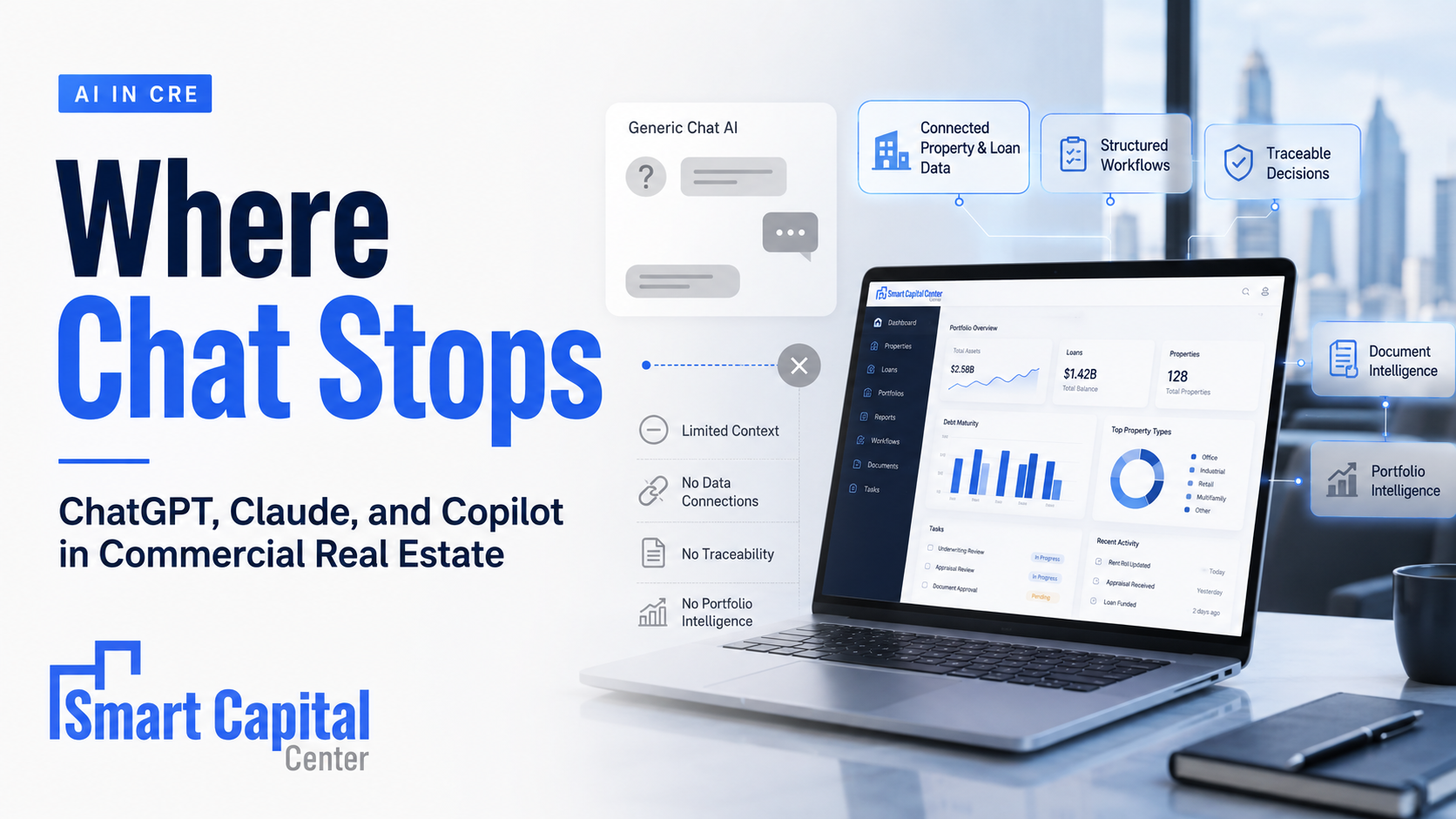
What’s the difference between using ChatGPT and a workflow-embedded AI like Smart Capital Center?
ChatGPT and similar generic copilots are useful for summarization, drafting, and quick research — the “stage one” experimentation Krashakova described. A workflow-embedded platform like Smart Capital Center is connected to the underwriting model, the rent roll, the loan covenants, and the integration layer (ARGUS, Yardi, Midland Enterprise, SS&C Precision), so it can act on data and feed structured outputs directly into committee memos and lender packages. The difference is between answering a question and executing a workflow with full audit trail.
Will AI replace CRE underwriters and asset managers?
No. AI removes the data-reconciliation and first-draft commentary layer that consumes most analyst time, but the analyst still owns interpretation, exception handling, and committee-grade judgment calls. Per McKinsey’s 2025 analysis, the most successful agentic AI deployments separate “steps” (repeatable tasks suited to AI) from “thoughts” (judgment calls that preserve human discretion). Teams using Smart Capital Center report reallocating analyst capacity to underwriting depth, deal screening, and investor relations — not headcount reduction.
How do CMBS servicers maintain compliance when using AI?
CMBS servicers maintain compliance by enforcing four guardrails on every AI-driven workflow: (1) sensitive borrower data is restricted from external systems; (2) human-in-the-loop review is required for every committee-grade output; (3) workflows are designed to be deterministic where possible, reducing prompt-injection and hallucination risk; and (4) every output is fully traceable back to its underlying data source. On Smart Capital Center, this is enforced at the platform layer — every commentary line, every risk flag, every covenant trigger is auditable end to end.
Should CRE firms build their own AI infrastructure or buy a platform?
The emerging consensus is hybrid: experiment internally to learn, but turn to external partners for production-ready, workflow-embedded systems. The cautionary tale is BloombergGPT — a 50-billion-parameter finance-specific LLM Bloomberg launched in March 2023 — which was outpaced within months by public model releases. Time to market is existential in CRE: a typical institutional team needs 24–36 months to assemble the data infrastructure (1B+ data points, 120M+ properties, 25+ external feeds) that Smart Capital Center delivers on day one.
How fast does CRE need to adopt AI?
Faster than most firms currently plan to. Per Deloitte’s 2025 outlook, 76% of CRE firms are still researching or piloting AI — only 24% have moved past those stages into production. With $2 trillion in CRE debt maturing through 2027 in a higher-rate environment than at origination, the window between experimentation and competitive disadvantage is approximately 18–36 months. The firms that embed AI into underwriting, servicing, and asset management workflows now will be the ones underwriting, lending, and managing portfolios at the pace the next CRE cycle demands.
Get started with Smart Capital Center: Book a demo today to see how AI-driven CRE intelligence applies to your underwriting, servicing, and asset management workflows.