

AI in Commercial Real Estate

July 30, 2026
AI in Commercial Real Estate
July 30, 2026

According to Deloitte’s 2025 Commercial Real Estate Outlook, 88% of global CRE leaders expect their company’s revenues to increase in 2025 — a sharp shift from the 60% who anticipated declines a year earlier. Yet 81% of those same leaders identify data and technology as the area where they most need to direct spending, and only 76% of CRE firms have moved past the research stage on AI adoption. JLL’s Global Real Estate Technology Survey found that 85% of real estate organizations still struggle to generate accurate, real-time information — the foundation every financial decision depends on. Every reporting cycle, lenders, investors, servicers, and asset managers face the same drag: financial analysis that takes days, not minutes. Why did OPEX rise 18% quarter-over-quarter? What explains a 3% dip in occupancy? How do T-12 actuals compare with the underwriting pro forma?
Smart Capital Center — the AI-powered CRE intelligence platform with $500B+ in analyzed transactions, 120M+ properties in its database, and institutional clients including KeyBank, JLL, RMR Group, Community Preservation Corporation, and Aareal Bank — has rebuilt this process from the ground up. By analyzing dozens of structured and unstructured data sources and generating consistent, professional commentary, the platform compresses financial analysis from a multi-day workflow into a real-time one. Variance reporting was the first workflow redefined with AI. It is now one of more than 50 AI-powered features spanning underwriting, forecasting, portfolio oversight, and asset management.
This is not paperwork automation. It is the structural change institutional CRE teams have spent the last five years trying to engineer in-house — now delivered as platform infrastructure that integrates directly with ARGUS, Yardi, Midland Enterprise, and SS&C Precision.
rely on it to monitor collateral performance and covenant compliance. Servicers use it to verify regulatory adherence on CMBS and construction loans. Asset managers depend on it for LP reporting, board updates, and quarterly investor letters. The output is the same in every case: an explanation of why revenue, expenses, and NOI shifted against budget or against the prior period.
The cost of producing those reports manually is substantial. Per Deloitte’s 2025 outlook, financial planning and analysis is the #1 area institutional CRE firms with AI in production are now prioritizing (43% of respondents) — ahead of risk management and property operations. The reason is simple: it is the workflow with the largest, most repetitive analyst-time burden. At Smart Capital Center, more than 8,000 variance reports are generated per month across the platform’s institutional customer base, making it the highest-volume financial workflow on the system and the logical first target for AI-driven redefinition.
What changed with AI:
• Multi-source narratives instead of single-line entries. Explanations now connect a financial shift to its operational and market drivers, not just to the prior-period number.
• Maintenance cost spikes are correctly attributed to deferred CapEx. Inspection report data is cross-referenced inline, so a 22% increase reads as a catch-up on overdue work, not as inefficiency.
• Occupancy dips are separated from market trend. A 3% decline is matched against rent roll move-outs and submarket vacancy, distinguishing property risk from market risk.
• Payroll increases are mapped to forward revenue signal. Temporary lease-up staffing is flagged as a leading indicator that revenue will follow within two quarters.
“Generative AI could unlock $110 billion to $180 billion in value across the global real estate industry.” — McKinsey & Company, Generative AI in Real Estate, 2024
Traditional variance reporting relies on financial statements and a few internal data points. Smart Capital Center’s variance engine ingests and cross-references far more — on every asset, every reporting cycle, in real time.
The data inputs include:
• Rent rolls, including tenant industry, lease term, escalations, and renewal probability
• Appraisals (full narrative and restricted-use)
• Property condition reports and engineering inspection findings
• Local and submarket data: CoStar, JLL Research, CBRE Research, Yardi Matrix
• Federal Reserve macroeconomic data (H.8 series for bank CRE lending; H.15 for rates)
• Trepp loan-level CMBS and bank-portfolio benchmarks
• Local zoning, regulation, and tax assessment updates
• Portfolio-level operating statements
• Unstructured sources: tenant communications, broker correspondence, regional news flow
By cross-referencing these signals in real time, the platform identifies correlations no human team can process at portfolio scale — linking utility-cost spikes to regional electricity rate changes, tying tenant turnover to broader employment shifts in the submarket, or flagging that a 4% retail rent decline aligns with a regional anchor tenant filing for bankruptcy.
Legacy variance reports are static — a number, a sentence, a footnote. Smart Capital Center’s commentary is interactive, regenerable, and audience-tunable. Three concrete shifts in output:
Multi-source automated explanations. Instead of “Maintenance expense rose 18%,” the platform generates: “Maintenance expenses rose 18% in Q2. Inspection reports surfaced deferred capital repairs totaling $187K from prior years, suggesting costs reflect a catch-up on overdue work, not ongoing operational inefficiency.” For occupancy: “Occupancy fell 3% this quarter, driven by two tenant move-outs flagged in the rent roll. Submarket vacancy rose 1.4 percentage points in parallel (CoStar Q2 2025), indicating market-level pressure rather than property-specific risk.”
Interactive follow-up. Users query the same model with natural-language follow-ups: “Why did payroll rise this month?” “Is marketing spend typical compared with last quarter?” “Which line items drove the NOI gap to budget?” Each query produces a new evidence-backed answer in seconds — with no report regeneration required.
Audience-tunable commentary. A credit committee, an institutional LP, and an internal asset management team need different framings of the same numbers. The platform regenerates commentary in concise, detailed, or risk-focused formats on demand — preserving full data integrity in every version.
The result: variance reporting moves from a backward-looking accounting exercise into a decision-grade input that lenders, investors, and committees can act on inside the same meeting.

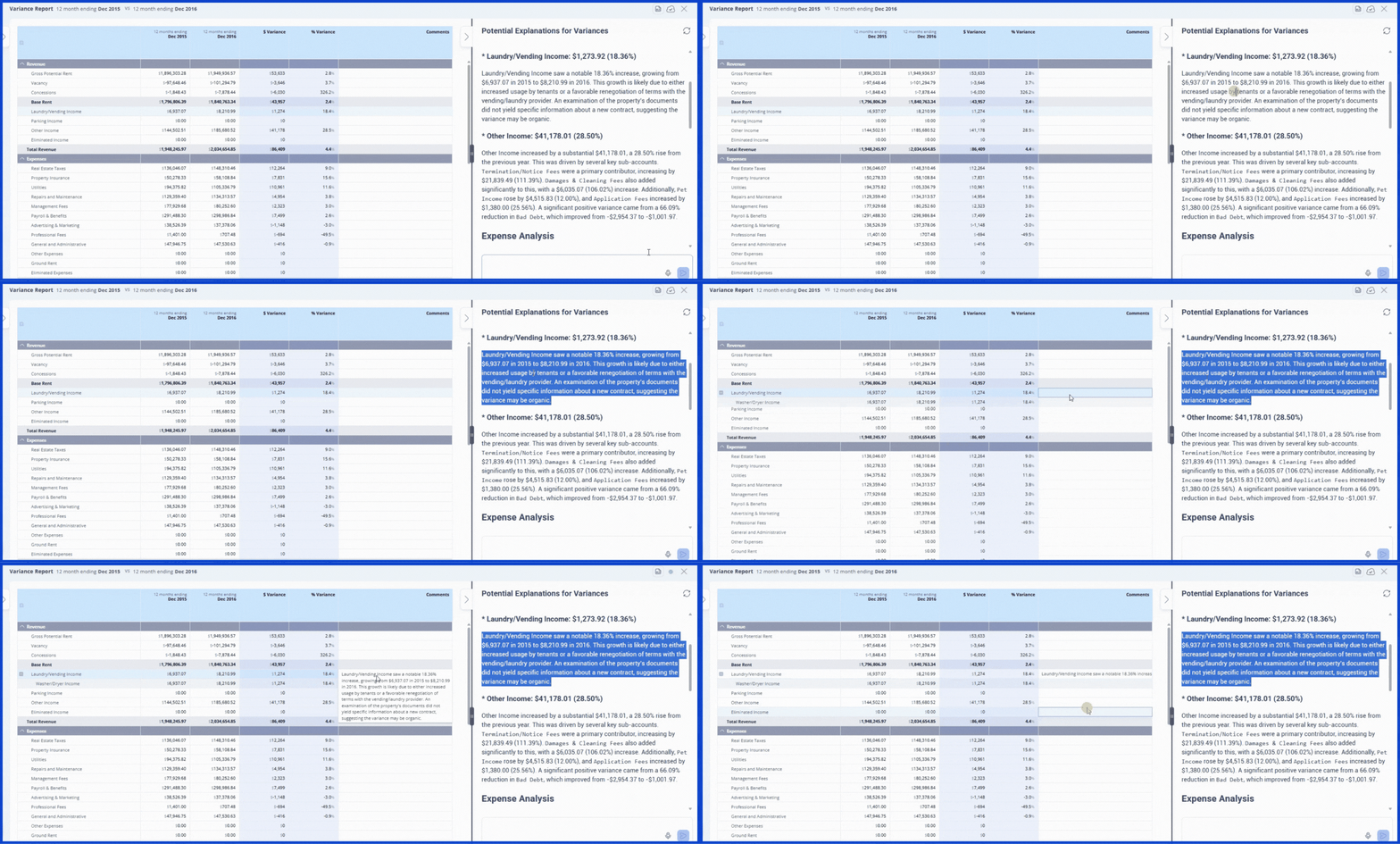
.gif)
This shifts variance reporting from static accounting notes into decision-ready insights, giving CRE investors and lenders confidence in the numbers.
Variance reporting is one workflow. The same intelligence layer now spans the full CRE financial analysis stack — a comparison detailed in our review of CRE underwriting and automation platforms:
• Acquisitions and investments. The platform reads historical financials, rent rolls, T-12s, and market comparables, then surfaces underwriting risks and value-add opportunities on a target asset within hours of receiving the data. JLL teams using this workflow have reported a 30x productivity gain in deal screening.
• Property and asset management. Anomalies in OPEX, CapEx, and tenant payment patterns are flagged in real time, with data-backed explanations that bypass the reactive posture of traditional reporting.
• Lending and servicing. Loan performance reports, draw approval files, and covenant monitoring outputs are produced continuously. KeyBank reduced financial model prep time by 40% on its CRE lending workflow using the platform.
• Portfolio oversight. Commentary is standardized across every asset, eliminating the inconsistency that plagues multi-analyst portfolio reviews and giving boards a single source of truth.
“SCC reduced our financial model prep time by 40%. What used to take three analysts a full day now takes one analyst two hours — with cleaner outputs and full traceability for our loan committee.” — Ken Schroeder, KeyBank
Financial analysis is no longer constrained by analyst headcount or reporting cadence. With AI built directly into the workflow, CRE teams gain four measurable shifts:
Faster reporting cycles. Asset-level variance, performance, and compliance reports are produced in minutes — a 50% acceleration in deal execution time, on average, for institutional users.
Deeper forecasting. NOI, rent growth, and OPEX projections are calibrated against 1B+ real-time data points and 36-month submarket absorption trends.
Proactive risk management. Tenant churn signals, rent compression, and covenant deterioration are flagged before they hit the financials — a leading-indicator posture, not a lagging-indicator one.
Improved transparency. Every commentary line is data-backed and auditable, strengthening trust with credit committees, LPs, and regulators.
“Financial analysis has already changed dramatically. It will never return to what it was. With AI, analysis is now superpowered by data, precision, and instant deep insight at a speed previously unimaginable.” — Laura Krashakova, CEO, Smart Capital Center
How does this compare to building it internally?
The platform’s 1B+ real-time data points, 120M+ property database, and pre-built integrations with ARGUS, Yardi, CoStar, and Midland Enterprise represent infrastructure that takes a typical institutional team 24–36 months to assemble — and another 18 months to maintain. Buying displaces that timeline by a factor of 10.

Variance reporting explains the past. Forecasting and risk management determine the future of every deal and every loan. The same intelligence layer handles both:
• Financial forecasting that tracks property-level performance against market trends and industry benchmarks, producing rolling 12-, 24-, and 36-month projections refreshed on every data update.
• Budget alignment that runs the asset’s rent roll, tenant credit profile, and OPEX line items against current submarket benchmarks — flagging where pro forma assumptions have drifted from market reality.
• Risk mitigation through anomaly detection: lease expirations clustering in a downturn quarter, tenant payment patterns deteriorating, operating margins compressing against peer assets.
Three risks every CRE team should ask the platform to surface every quarter:
1. Which tenants in the rent roll show payment timing or amount deterioration vs. their 12-month baseline?
2. Which OPEX line items show growth materially above the submarket benchmark?
3. Which loans in the portfolio are within 18 months of maturity in a markedly different rate environment than at origination?
Is this just another business intelligence dashboard? No. Dashboards report the past. The platform models the future — running multidimensional NOI and CapEx scenarios under stress in real time, giving boards and LP committees risk-adjusted visibility under volatility. McKinsey’s 2025 analysis on agentic AI in real estate estimates that automation applied to knowledge work could unlock $430–$550 billion in annual global value across real estate, construction, and development — a wave of value institutional teams using backward-looking tools are structurally positioned to miss
AI-driven financial analysis is one capability inside Smart Capital Center’s full CRE workflow platform. It can be deployed standalone or as part of the integrated lifecycle suite — currently spanning more than 50 AI-powered features:
• Deal screening — automated deal evaluation, pipeline tracking, and centralized deal database creation.
• Underwriting — pro forma generation, DCF analysis, IRR and ROI calculations, and stress-tested sensitivity modeling.
• Asset management — real-time monitoring of rent, expenses, and NOI trends, with benchmarking, tenant tracking, and 24/7 AI-agent portfolio surveillance.
• Reporting — automated investment memos, lender packages, credit memos, asset summaries, and portfolio-level reports.
• Debt management — end-to-end oversight of loan terms, covenant compliance, key dates, and automated alerts.
The platform also provides 24/7 AI analyst and agent support, ensuring continuous monitoring, risk flagging, and actionable insights across every stage of the investment and lending lifecycle. Every output is fully traceable back to its underlying data source — a non-negotiable for credit committees, audit teams, and LP investor relations. For a deeper look at how each module fits into the broader CRE technology stack, see our ongoing analysis on the Smart Capital Center blog.
Variance explanations remain a structural part of CRE finance. They are no longer the bottleneck. From underwriting and forecasting to loan oversight and portfolio management, financial analysis is the backbone of CRE decision-making — and that backbone is being rebuilt.
Three questions institutional CRE teams should answer this quarter:
How long does your team currently take to produce a quarterly variance commentary across the full portfolio?
If the answer is more than 48 hours, your reporting infrastructure is now a competitive disadvantage.
How many external data sources are reconciled in your standard variance report?
If the answer is fewer than 10, you are explaining numbers without context.
Can your credit or LP committee query a portfolio-level question and receive a data-backed answer in the same meeting?
If the answer is no, your decision velocity is structurally constrained.
Smart Capital Center delivers the answer to all three. Financial analysis itself is being redefined by AI — and the firms that adopt it now will be the ones underwriting, lending, and managing portfolios at the pace the next CRE cycle demands.
The future of CRE finance is not theoretical. It is in production today — across origination, asset management, and portfolio oversight — at firms including KeyBank, JLL, RMR Group, and Community Preservation Corporation. Teams using Smart Capital Center analyze faster, act earlier, and decide with sharper data than the workflow they are leaving behind.
Get started with Smart Capital Center: Book a demo today to see how AI-driven financial analysis applies to your portfolio.
What is AI-powered financial variance reporting in commercial real estate?
AI-powered variance reporting is the use of machine-learning models to automatically explain why a property’s revenue, expenses, or NOI shifted against budget or the prior period — by cross-referencing financial statements with rent rolls, inspection reports, market data, and unstructured signals like tenant communications. Instead of an analyst manually drafting a one-line explanation, the platform produces a multi-source narrative in minutes. On Smart Capital Center, that cycle drops from 6–10 analyst-hours per asset to under 5 minutes, with 25+ data sources reconciled in every report.
How long does AI variance reporting take compared to manual workflows?
Manual variance reporting typically takes 6–10 analyst-hours per asset and a 5–7 business-day cycle to complete a portfolio. Smart Capital Center compresses that to under 5 minutes per asset and a sub-24-hour portfolio cycle. The acceleration comes from the platform reading and reconciling source documents in parallel, then drafting commentary directly into the same model the analyst reviews.
Will AI replace CRE analysts for financial reporting?
No. AI removes the data-reconciliation and first-draft commentary layer that consumes most analyst time, but the analyst still owns interpretation, exception handling, and committee-ready judgment calls. Per McKinsey’s 2025 analysis on agentic AI in real estate, the most successful deployments use AI to handle repeatable steps while preserving human judgment for risk, exceptions, and trade-offs. Teams using Smart Capital Center report reallocating analyst capacity to underwriting, deal screening, and investor relations — not headcount reduction.
Does Smart Capital Center integrate with ARGUS, Yardi, and Midland Enterprise?
Yes. Smart Capital Center integrates directly with ARGUS Enterprise, Yardi, Midland Enterprise, SS&C Precision, and any system via API. Data flows in both directions, eliminating the manual reconciliation step that costs institutional teams an average of 12 analyst-hours per reporting cycle. Existing models, templates, and chart-of-accounts mappings are preserved — the platform layers on top of the current stack rather than replacing it.
What data sources does the platform use for variance analysis?
The platform ingests rent rolls, T-12 financials, appraisals, inspection reports, lease documents, and operating statements — then cross-references them against external market data from CoStar, JLL Research, CBRE Research, Yardi Matrix, Federal Reserve H.8 and H.15 series, Trepp CMBS benchmarks, and local zoning and tax records. Unstructured sources including tenant communications, broker correspondence, and regional news flow are also processed. In total, more than 25 data sources are reconciled in a standard variance report — versus 3–5 in a typical manual workflow.
How does AI improve CRE forecasting accuracy?
AI improves forecasting accuracy in three measurable ways: (1) it calibrates property-level NOI, rent growth, and OPEX projections against 1B+ real-time data points and 36-month submarket absorption trends, rather than against last year’s budget; (2) it detects anomalies in tenant payment timing, OPEX line items, and lease rollover risk before they appear in the financials; and (3) it runs multidimensional stress scenarios on the same model in real time, giving boards and LP committees risk-adjusted visibility under volatility. The output is a leading-indicator forecasting posture, not a lagging-indicator reporting one.
Is AI-driven CRE financial analysis suitable for regulated lenders and CMBS servicers?
Yes. Every output on Smart Capital Center is fully traceable back to its underlying data source — a non-negotiable for credit committees, audit teams, regulators, and CMBS trustees. The platform is in production at institutional lenders including KeyBank and Aareal Bank, and at CMBS-active firms like Tremont Realty Capital. Audit-trail completeness, covenant-compliance monitoring, and regulator-ready reporting are built into the workflow, not added as a layer.
Get started with Smart Capital Center: Book a demo today to see how AI-driven financial analysis applies to your portfolio.