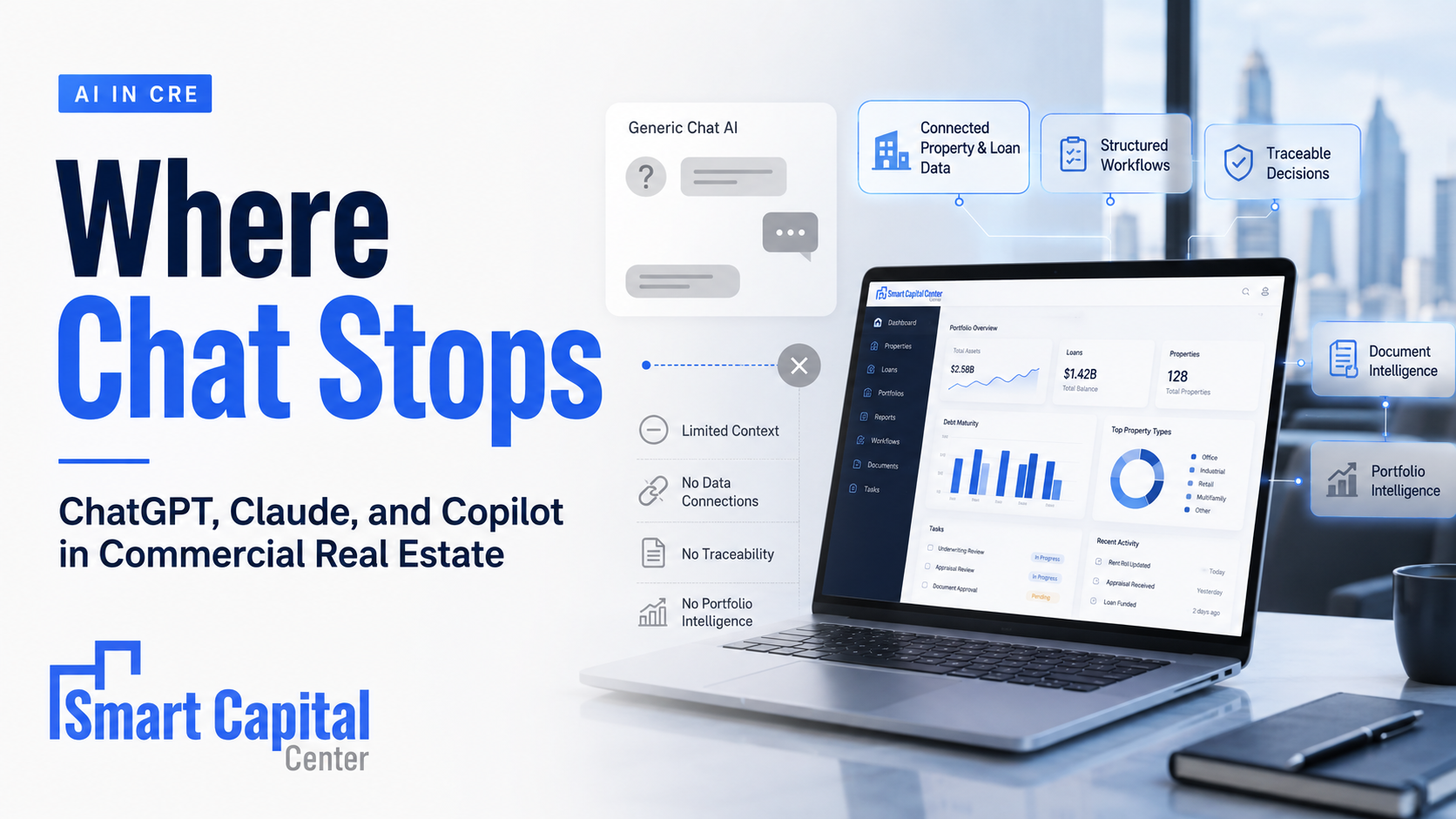


AI in Commercial Real Estate

July 30, 2026
AI in Commercial Real Estate
July 30, 2026
According to Deloitte’s 2025 Commercial Real Estate Outlook, financial planning and analysis is now the #1 priority area (43% of respondents) for CRE firms with AI fully in production — ahead of risk management (37%) and property operations (35%). McKinsey estimates generative AI could unlock $110–$180 billion in value across the global real estate industry. The competitive question for institutional investors and underwriters is no longer whether to use AI in CRE underwriting, but how fast they can move from generic copilots to workflow-embedded intelligence.
Smart Capital Center’s latest webinar united top investment firms and underwriting teams nationwide — institutional investors, asset managers, debt funds, and lenders — for a live showcase of AI-driven underwriting in practice. The session featured a real-world retail case study: La Jolla Village Square, a landmark shopping center in San Diego, California. By applying AI and Deep Research to this asset, Smart Capital Center showed how underwriting moves from days of manual reconciliation to real-time analysis on a platform with $500B+ in analyzed transactions, 120M+ properties in its database, and institutional clients including KeyBank, JLL, RMR Group, and Tremont Realty Capital.
“Smart Capital Center is specifically crafted for commercial real estate, unlike general AI tools. Each feature — from processing financial data to tracking risks — is tailored for CRE documents, workflows, and investment scenarios.” — Hannah Kidd, Senior Financial Associate, Smart Capital Center
Here are the key takeaways from this session:
Underwriting is reimagined with AI co-pilots
Traditional underwriting requires hours of manual data entry, reconciliation, and document review for every asset. Smart Capital Center ingests and standardizes financial statements, rent rolls, appraisals, and offering memorandums in minutes — a workflow that previously took 30–40 minutes per financial statement now completes in 1–3 minutes.
Every analysis remains fully transparent and subject to analyst review. Firms keep their existing underwriting models, benchmarks, and chart-of-accounts mappings — the platform layers on top of the current stack rather than replacing it. The manual steps that historically slowed execution disappear; the proprietary methodology that defines a firm’s edge stays intact.
Analysts retain full transparency — every data point links back to its source document — while gaining immediate variance analyses, visualizations, and reconciliations.
“You can think of us as your co-pilot in commercial real estate — helping you make smarter, faster decisions with real-time data, AI-powered underwriting, and unmatched market intelligence.” — Garrett Brewer, Director of Sales, Smart Capital Center
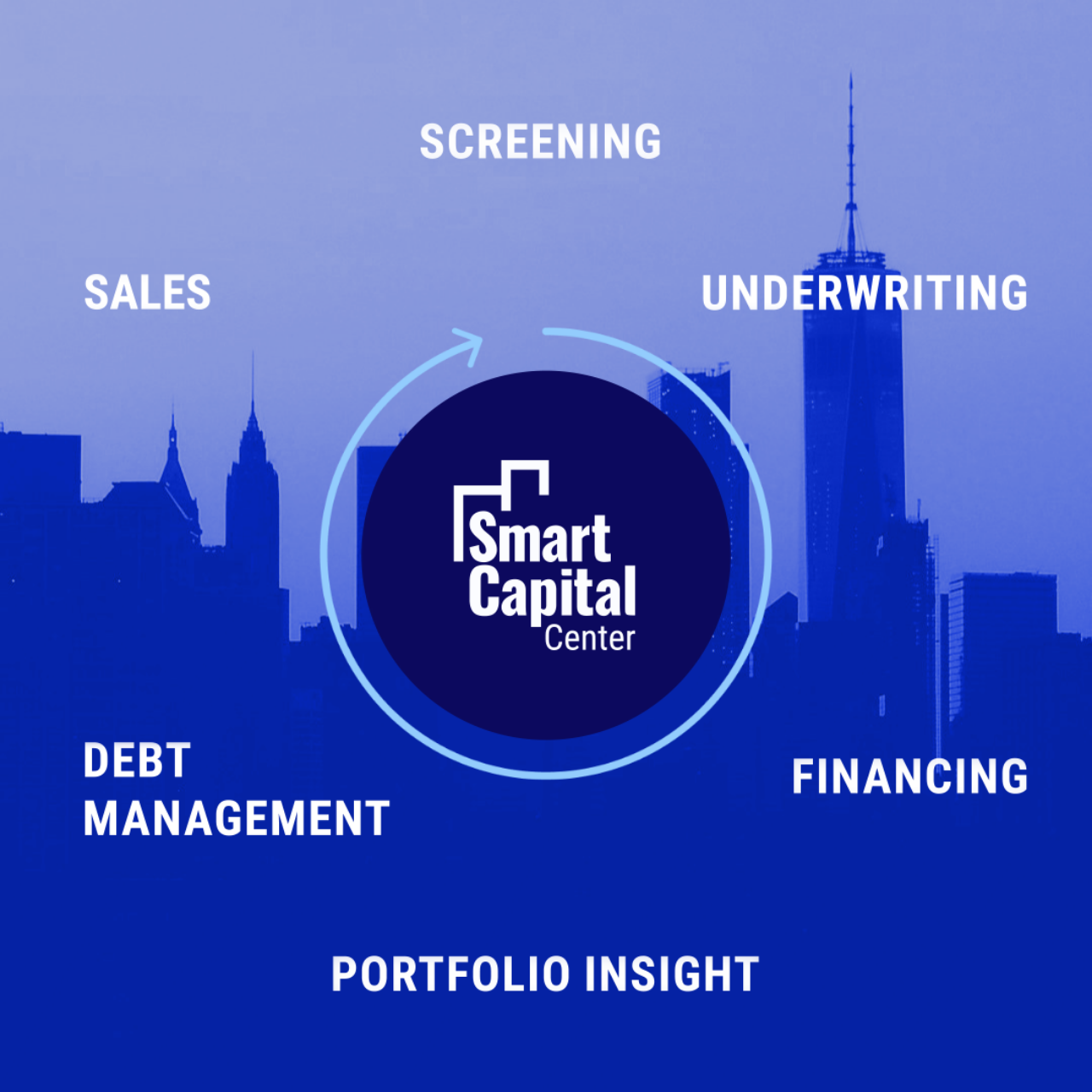
Smart Capital Center isn’t a point solution. It’s an end-to-end platform spanning origination, underwriting, portfolio monitoring, loan management, risk analysis, and disposition — a comparison detailed in our review of CRE underwriting and automation platforms. By embedding AI across the full investment lifecycle, firms process more deals, identify risks earlier, and execute faster.
Smart Capital Center clients — including JLL, RMR Group, Tremont Realty Capital, Aareal Bank, and KeyBank — are already operating in this mode. These teams are running AI-powered underwriting, real-time market intelligence, and automated reporting that replaces hours of manual work with transparent, source-linked insights.
Five lifecycle stages, one platform:
• Origination and deal screening — automated deal evaluation, pipeline tracking, and centralized deal database creation.
• Underwriting — pro forma generation, DCF analysis, IRR and ROI calculations, and stress-tested sensitivity modeling against 1B+ real-time data points.
• Asset management — real-time monitoring of rent, expenses, and NOI trends, with benchmarking, tenant tracking, and 24/7 AI-agent portfolio surveillance.
• Reporting — automated investment memos, lender packages, credit memos, asset summaries, and portfolio-level reports.
• Debt management and disposition — end-to-end oversight of loan terms, covenant compliance, key dates, automated alerts, and exit modeling.
Generative AI in CRE goes beyond data extraction. Smart Capital Center continuously scans market data, regulatory shifts, and tenant news to surface signals that would be impossible to track manually at scale. Per CoreSight Research, 7,327 retail stores closed in 2024 — a 57.8% increase over 2023 — driven by major bankruptcies including Big Lots, Joann, Party City, The Container Store, and Forever 21. When a portfolio holds tenant exposure to any of these names, the platform proactively flags which properties are impacted and quantifies the rent-roll exposure within hours of the filing, not weeks later.
This is especially powerful in two critical workflows:
• During acquisitions. When a property is being screened by investment teams at private equity firms, operators, or lenders, the quality of the rent roll determines the deal. AI Deep Research adds a new dimension to diligence by connecting tenant exposure to real-time market and credit events — tenant credit ratings, parent-company news, regional employment shifts — surfacing risks that manual review would miss.
• During asset management. Once acquired, surveillance analysts and asset managers at private equity firms, debt funds, and other CRE investors use the platform for continuous monitoring. AI agents operate in the background 24/7, scanning for tenant credit events, regulatory changes, and market movements — turning monitoring from a quarterly review cycle into a proactive defense of NOI and risk-adjusted returns.
The result: workflows shift from reactive to proactive in real time. Teams gain intelligence to protect cash flow, mitigate tenant risk early, and uncover opportunities long before competitors.
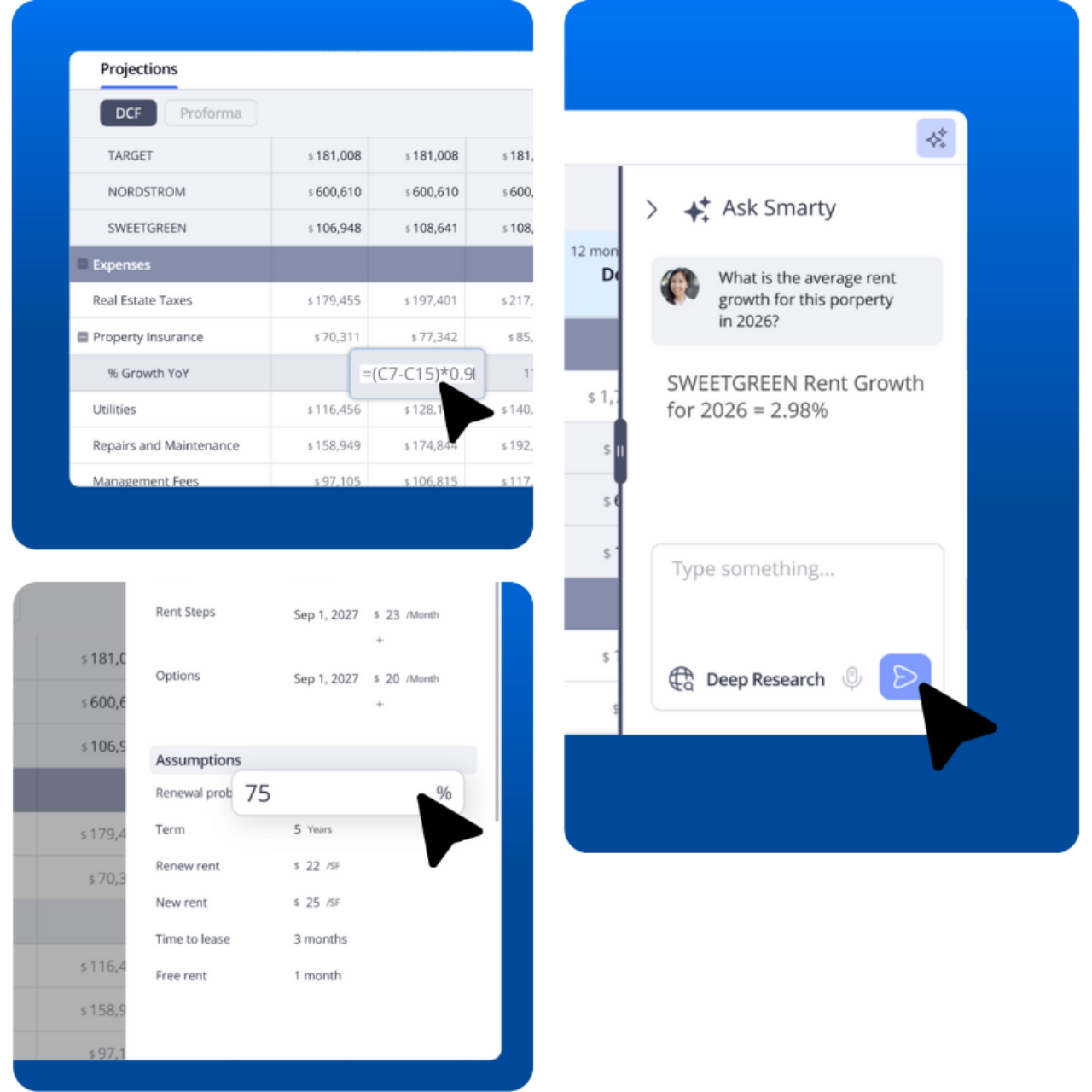
Meet Smarty, the AI analyst built specifically for CRE. Unlike a generic chatbot, Smarty has full context of your portfolio, properties, tenants, and financials. It doesn’t just retrieve data — it reasons over it, runs scenarios, and explains results in plain language.
Where Smarty is most useful in the investment lifecycle:
Pre-deal screening and underwriting. Accelerates diligence by answering questions that would normally take hours of modeling and reconciliation.
Portfolio monitoring. Operates as a 24/7 analyst, surfacing early warnings (lease expirations, tenant distress, covenant risk) so teams can act proactively.
Investment memo generation and reporting. Produces draft investment memos, ASRs, and portfolio reports in minutes, pulling directly from source documents and real-time benchmarks.
For CRE investment teams managing hundreds of properties, the scale shift is structural: instead of weeks of back-and-forth analysis, Smarty delivers institutional-grade answers in seconds, giving teams effective analyst capacity that does not require new headcount.
Instead of weeks of back-and-forth analysis, Smarty enables on-demand, institutional-grade answers in seconds. For CRE investment teams managing hundreds of properties, the scale is unmatched: one AI Smarty assistant effectively functions like 100 analysts working around the clock, delivering immediate insights without increasing headcount.
Smart Capital Center equips teams with always-on AI agents working around the clock. This doesn’t replace people; it redirects them. Underwriters and analysts shift from repetitive data-entry tasks to higher-value decision-making, exception handling, and committee-grade judgment calls.
Per McKinsey’s 2025 analysis on agentic AI in real estate, the most successful deployments separate “steps” (repeatable tasks suited to AI execution) from “thoughts” (judgment calls that preserve human discretion). McKinsey estimates this human-plus-agent operating model could unlock $430–$550 billion in annual global value across real estate, construction, and development. Early adopters — including KeyBank — are reporting dramatically faster financial model preparation and significant time savings across underwriting workflows.
Clients like JLL, RMR Group, and KeyBank are experiencing measurable, game-changing results with Smart Capital Center.
Fernando Salazar, Director of Asset Management at JLL, shared:
“Instead of the 30–40 minutes it took us previously to process a single financial statement, now it takes 1–3 minutes with Smart Capital Center.”
That’s a 30x productivity gain in one of the most repetitive but critical workflows of underwriting and asset management.
Other early adopters are reporting similar impact:
These gains translate directly into scale, speed, and ROI. Analysts and asset managers shift from manual data entry to higher-value decision-making. Firms move from reactive monitoring to proactive intelligence. And leadership teams gain the confidence of knowing every decision is grounded in source-linked, AI-powered analysis.

In the live demo at La Jolla Village Square, , Smart Capital Center surfaced the property’s complete history — ownership changes, mortgage records, prior valuations — alongside detailed market intelligence: demographics, business statistics, location popularity scores, amenities, and foot-traffic patterns. All consolidated into one decision-ready market view, derived from CoStar, JLL Research, CBRE Research, Yardi Matrix, Federal Reserve macroeconomic data, and the platform’s 1B+ real-time data points.
Tenant analytics added another dimension: real-time monitoring of financial exposure, tenant operating and financial performance, industry health, and online sentiment — the kind of signal that historically required dedicated credit-research staff to surface.
“If there’s any negative news affecting a tenant, the analyst or asset manager gets notified right away so you can act immediately.” — Hannah Kidd, Senior Financial Associate, Smart Capital Center
Traditional DCF models depend on fixed assumptions — rent growth, occupancy rates, operating costs, market comparables — that often diverge from current market reality the moment they are written. Smart Capital Center transforms this process by embedding Deep Research directly into the underwriting workflow.
With Deep Research, every DCF assumption is tested against real-time market data, benchmarks, third-party research reports, and local comps. When an analyst projects 3% rent growth or a 65% expense ratio, the system checks the input against dozens of similar properties in the same submarket, recent CBRE and JLL reports, online listings, and proprietary databases linked to the platform. The result is underwriting grounded in current, local, evidence-based data — not stale assumptions copied from the last deal.
How it works in practice:
1. AI agents read rent rolls, financial statements, T-12s, and offering memorandums, then cross-reference them against tenant news, regulatory updates, and demographic trends pulled from external feeds.
2. Variance drivers are surfaced automatically: rising utility costs, local tax changes, submarket vacancy shifts — each linked to its source and quantified for NOI and long-term value impact.
3. Analysts compare proprietary assumptions against market data: cap rates, lease rollover expectations, expense ratios. Confidence in upside and downside cases is grounded in evidence, not in last quarter’s deck.
This combination of DCF modeling and AI Deep Research delivers an accuracy level manual methods cannot match. Underwriting moves from “best guess” to a data-driven process — helping firms price risk more accurately and uncover hidden opportunities in their assumptions.
Scenario modeling and Excel integration
The platform automatically builds pro formas and DCFs while integrating directly with existing Excel models, ARGUS Enterprise, Yardi, Midland Enterprise, SS&C Precision, and any system via API. Analysts maintain familiar workflows while gaining the benefits of automation and full source-linked transparency.
All results export back to Excel, ensuring investment teams continue to use their preferred models and reporting templates without disruption. Generative AI further enhances financial analysis by comparing performance across periods and explaining the underlying drivers of change — highlighting whether a variance stems from seasonal utility costs, tax adjustments, or other operating factors. Raw numbers become actionable insight without leaving the analyst’s existing toolkit.
Financial analysis is more than just pulling together statements—it’s about explaining what’s happening, anticipating what’s coming, and giving teams actionable insight. Smart Capital Center applies AI to do exactly that across underwriting, monitoring, reporting, and risk management.
Financial analysis is no longer about understanding the past. It is about influencing the future. When teams know why numbers changed, they can predict better, adjust their models or DCFs, and act before small issues become large ones. The result: more defensible valuations, more accurate underwriting, and greater portfolio agility.
“Smart Capital Center is made just for commercial real estate. Every insight — from rent rolls to tenant exposure — is designed for real estate investing. This ensures analysis is not just fast, but contextually relevant to acquisitions and asset management.” — Garrett Brewer, Director of Sales, Smart Capital Center
A frequent question from CRE firms evaluating AI: is my data safe?
Yes. For CRE firms operating under FFIEC, SOX, and CMBS pooling and servicing agreements, data security isn’t optional — it is foundational. Smart Capital Center has strong protections, follows strict frameworks, and ensures clear accountability at every layer.
“All the information you upload is secure and just for you. We currently work with regulated entities such as banks, insurance companies, and government agencies.” — Garrett Brewer, Director of Sales, Smart Capital Center
Two pillars of the security architecture:
1. Certified and audited. Smart Capital Center holds SOC 2 Type 2 and ISAE-3000 compliance, with regular independent audits and strict controls over process, infrastructure, and risk management.
2. Full control over models and data usage. Customers decide which AI models to use — their own private LLMs, third-party providers, or the internal Smart Capital Center model. Customer data does not leak to public model training, ever.
“This flexibility lets CRE investors choose how to use AI in their underwriting and asset management. Their unique methods stay private and under their control.” — Hannah Kidd, Senior Financial Associate, Smart Capital Center
"This flexibility lets CRE investors choose how to use AI in their underwriting and asset management. This way, their unique methods stay private and under their control." - Hannah Kidd, Senior Financial Associate, Smart Capital Center
AI is restructuring how firms handle CRE underwriting and asset management. Per the JLL Global Real Estate Technology Survey, 85% of real estate organizations still struggle to generate accurate, real-time information — the foundation every underwriting decision depends on. Smart Capital Center closes that gap by giving teams real-time visibility instead of quarterly hindsight.
Five proactive capabilities Smart Capital Center delivers on day one:
• Real-time risk alerts. The platform watches tenant credit events, lease exposures, and market changes — flagging risks before they materialize on the balance sheet.
• Real-time scenario modeling. Teams model changes in rent growth, occupancy, or expenses and see immediate impact on NOI, DSCR, and IRR — no waiting for the next reporting cycle.
• 24/7 AI analysts. Always-on agents review financials, check rent rolls, and provide insights through every business hour and outside of them — expanding analyst capacity without expanding headcount.
• Market and tenant intelligence. Deep Research links regulatory updates, news, and tenant changes directly to portfolios, surfacing risks that manual workflows miss.
• Source-linked transparency. Every alert, projection, and analysis links back to the original document or benchmark — giving leadership confidence to act quickly.
The result: a structural shift from slow reaction to fast, evidence-based decision-making. CRE firms protect returns, act faster on deals, and surface opportunities ahead of competitors.
AI in CRE is not a someday story. It is in production today. With Smart Capital Center, acquisitions, underwriting, and asset management evolve from manual, reactive processes into real-time, proactive intelligence.
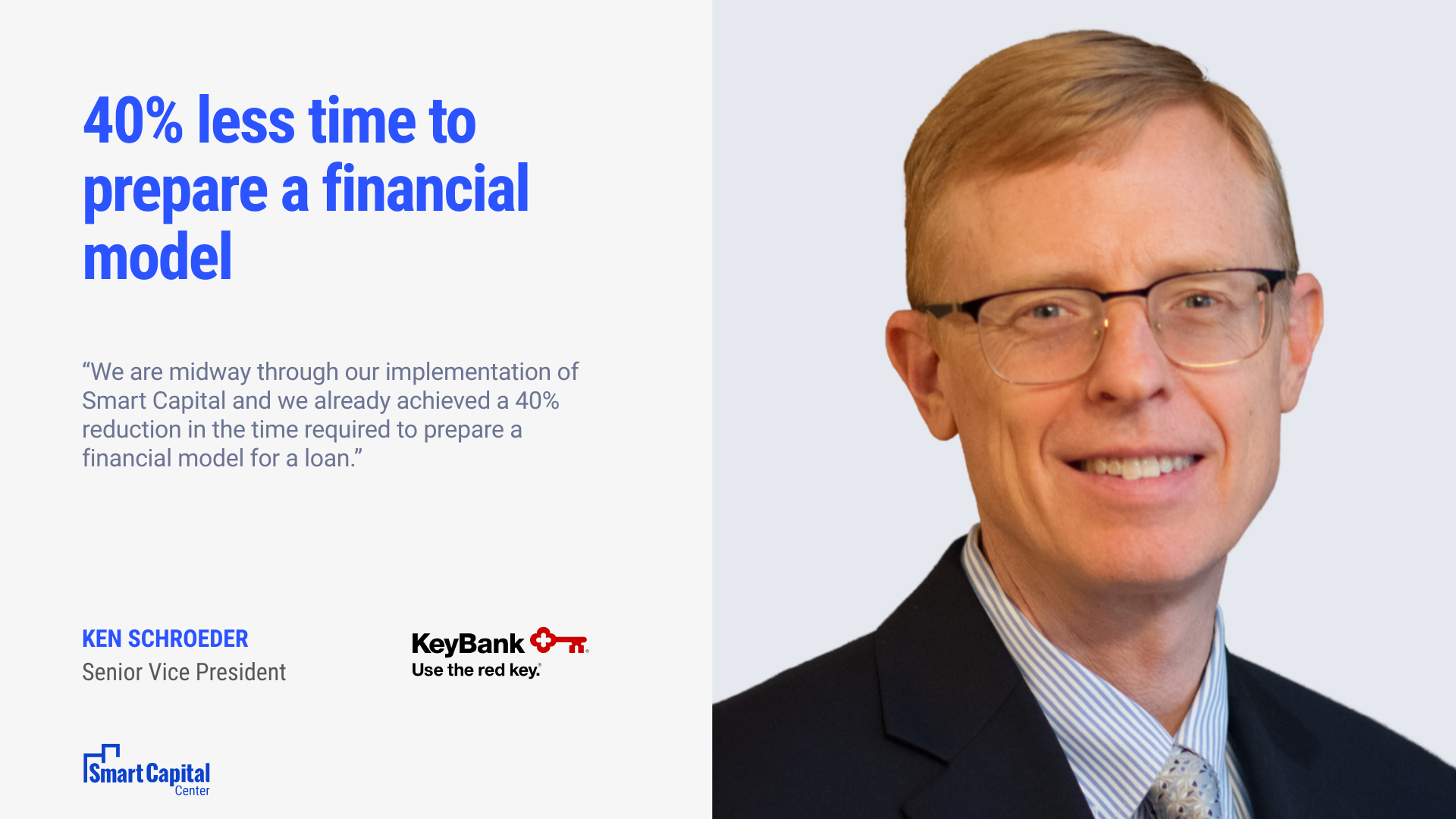
Investment teams using the platform see clear benefits: 30x faster financial statement processing (per Fernando Salazar, JLL), 40% reduction in financial model prep time on CRE lending workflows (per KeyBank), and reporting cycles compressed from 5–7 business days to under 24 hours — all while preserving human judgment, proprietary methodology, and existing workflow infrastructure.
The platform is purpose-built for commercial real estate. It helps investors, asset managers, and lenders move faster, scale confidently, and surface opportunities before competitors. The future of underwriting lies in real-time Deep Research — and it has already begun.
What is AI-powered CRE underwriting?
AI-powered CRE underwriting uses machine-learning models to automate the data extraction, financial modeling, market research, and risk analysis steps that traditionally consume the largest share of underwriter analyst time. Instead of an analyst manually entering rent roll data, building a DCF, and pulling market comps, the platform processes these in parallel and produces a source-linked underwriting model in minutes. On Smart Capital Center, financial statement processing drops from 30–40 minutes per statement to 1–3 minutes — a 30x productivity gain reported by JLL.
How does AI Deep Research differ from traditional underwriting analysis?
Traditional underwriting analysis relies on fixed assumptions, static comps, and last-quarter market data. AI Deep Research tests every assumption — rent growth, occupancy, expense ratios, cap rates — against live market data, third-party research from CoStar, JLL, and CBRE, tenant news, and regulatory updates the moment they appear. Per Deloitte’s 2025 outlook, 43% of CRE firms with AI in production now prioritize this kind of financial planning and analysis above any other AI workload.
Can Smart Capital Center integrate with my existing Excel models, ARGUS, and Yardi?
Yes. Smart Capital Center integrates directly with Microsoft Excel, ARGUS Enterprise, Yardi, Midland Enterprise, SS&C Precision, and any system via API. Existing models, templates, and chart-of-accounts mappings are preserved — the platform layers on top of the current stack rather than replacing it. Data flows in both directions, so analysts can export AI-generated outputs back into their preferred reporting templates without disruption.
Is my data secure when using AI underwriting tools?
Yes. Smart Capital Center holds SOC 2 Type 2 and ISAE-3000 compliance, with regular independent audits and strict controls over data, infrastructure, and risk management. Customer data is never used to train public AI models. Customers can choose whether to run analyses on their own private LLMs, third-party providers, or the internal Smart Capital Center model — control stays with the firm. The platform is in production at regulated entities including KeyBank and Aareal Bank, where FFIEC and SOX compliance are non-negotiable.
How long does it take to underwrite a property with Smart Capital Center?
Initial underwriting outputs — ingested rent roll, T-12 financials, pro forma, DCF, and market comparables — are typically produced in under one hour for a single property, compared with the multi-day cycle that defines manual underwriting. KeyBank reports a 40% reduction in financial model prep time on its CRE lending workflow. RMR Group has reported underwriting cycle compression that has redirected analyst time from manual reconciliation to portfolio strategy.
Will AI replace CRE underwriters and analysts?
No. AI removes the data-entry, reconciliation, and first-draft modeling layers that consume most analyst time, but the analyst still owns interpretation, exception handling, and committee-grade judgment. Per McKinsey’s 2025 analysis, the most successful agentic AI deployments separate “steps” (repeatable tasks suited to AI execution) from “thoughts” (judgment calls that require human discretion). Teams using Smart Capital Center report reallocating analyst capacity to deeper underwriting reviews, deal screening, and investor relations — not headcount reduction.
What kinds of CRE firms are using AI underwriting today?
AI-powered underwriting is in production at institutional investors, debt funds, regional banks, CMBS-active firms, REITs, and asset managers. Smart Capital Center’s named institutional clients include KeyBank (regional lender), JLL (institutional services), RMR Group (REIT manager), Tremont Realty Capital (CMBS-active), Aareal Bank (regulated lender), and Community Preservation Corporation (mission-driven lender). The common pattern: firms with high deal volume, complex portfolios, or strict reporting requirements are moving fastest.
Get started with Smart Capital Center: Book a demo today to see how AI-powered underwriting and Deep Research apply to your portfolio.